The right purchase depends first on the camera signal: analogue and HD-over-coax systems use a 75-ohm video path, while IP cameras normally use Cat5e or Cat6 Ethernet. You will be able to match the cable, connectors, power arrangement, outdoor protection, distance claims and dealer documents to your installation instead of treating every product labelled CCTV cable as interchangeable.
Key takeaways
- Confirm 75-ohm impedance before ordering either cable type.
- Compare attenuation, shielding and usable distance for your camera format.
- Use compatible BNC connectors and weatherproof every exposed joint.
- Request datasheets, batch details and termination guidance from the dealer.
Does Polycab CCTV cable differ from Polycab coaxial cable?
Polycab CCTV cable and Polycab coaxial cable can describe the same 75-ohm video path, but they do not always describe the same finished cable. For analogue CVBS, HD-TVI, AHD and HD-CVI cameras, compare impedance, attenuation, shielding and termination before treating either product as interchangeable.
| Construction | What it carries | Where it applies |
|---|---|---|
| 75-ohm coaxial cable | Video only | Analogue and HD-over-coax cameras connected to a DVR |
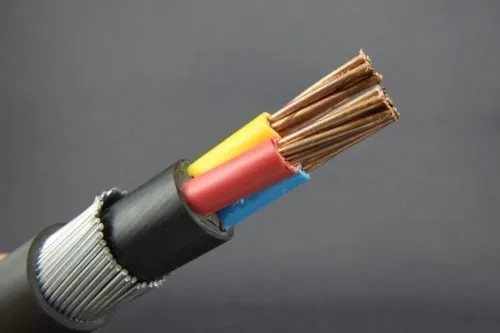
| Siamese CCTV cable | 75-ohm coaxial video core plus a separate two-core DC power pair | Cameras needing video and local low-voltage power in one run |
| Cat5e or Cat6 Ethernet | Balanced network data, with PoE supplied by compatible equipment | IP cameras connected to a network switch, NVR or PoE switch |
A Siamese assembly is still not an Ethernet or PoE cable. Its second pair carries DC power; it does not provide Ethernet data or become PoE simply because it sits beside the coaxial core.
IP cameras normally require Cat5e or Cat6, so do not substitute a coaxial CCTV reel for an IP-camera cabling requirement. Ask which camera format the system uses before comparing Polycab dealer coaxial cable versus CCTV cable in Bengaluru.
Then confirm whether the quotation covers video only, video plus power, or Ethernet data. The label “CCTV cable” alone does not answer that question.
How should you select cable for a Bengaluru CCTV installation?
Choose 75-ohm coaxial or Siamese cable for analogue CVBS and HD-over-coax cameras, including HD-TVI, AHD and HD-CVI. Choose Cat5e or Cat6 for IP cameras, with PoE equipment only when the camera, switch and complete cable system support it.
| Option | Best fit | Route and power arrangement |
|---|---|---|
| 75-ohm coaxial | Analogue or HD-over-coax camera | Separate DC power cable; verify video attenuation |
| Siamese cable | Small indoor analogue installation | Coaxial video core plus dedicated two-core DC power pair |
| Cat5e or Cat6 | IP camera | Ethernet data to an NVR or network switch; PoE where specified |
For a small indoor installation, Siamese cable can remove separate power wiring. In a larger building, map every camera to its recorder, power source or network switch, then count each joint, patch point and splitter.
Do not accept a generic maximum distance for a long run. Compare the actual cable grade, video format, connectors and receiver specification. For Siamese cable, check video attenuation separately from DC voltage drop: V-drop = 2 × one-way length × current × conductor resistance per metre.
Use the higher camera current when infrared illumination turns on at night.
Outdoor, rooftop, compound and exposed shaft routes need a jacket rated for UV, moisture and the expected temperature. Use conduit, suitable glands and weatherproof junction boxes where required; indoor PVC cable is not automatically suitable. Before ordering polycab cctv cable in bengaluru, request the exact construction datasheet, including maximum bend radius and installation conditions.
Which cable specifications determine signal quality and usable distance?
Impedance is the first filter: match 75 ohms across the cable, camera output, recorder input and connectors. A 50-ohm RF cable can connect through an adaptor, but the mismatch can cause reflections, loss and unreliable video.
| Specification | What to compare | Why it matters |
|---|---|---|
| Conductor | Solid or stranded bare copper versus copper-clad aluminium (CCA); size in mm² or AWG; resistance per metre | CCA has higher resistance than copper of the same nominal size, increasing voltage drop |
| Dielectric and shield | Insulation material and diameter; foil, braid or equivalent screening; braid coverage | Determines signal loss, interference rejection and mechanical strength |
| Transmission data | Attenuation at the camera format’s signal frequencies | Indicates usable performance more accurately than the cable name |
| Installation | Jacket construction, temperature range, reel length and stated bend radius | Prevents damage and unsuitable routing |
| System details | HD-over-coax format, connectors, joints and test conditions | Makes any stated distance meaningful |
Do not compare outside diameter alone; it does not reveal conductor resistance or shield coverage. A single “maximum distance” is meaningless unless it names the format, cable construction, connectors, joints and test conditions.
Request attenuation and installation data for the exact Polycab product before approving a run, including from a Polycab coaxial cable in Bengaluru supplier. For Siamese cable, assess the video coax and power pair separately: the pair’s resistance and length determine DC voltage drop, especially when infrared lights switch on.
Which connectors and protection details prevent installation faults?
Prevent installation faults by matching the connector to the equipment and the cable construction, then protecting every route and joint. Do not choose a connector from the cable’s appearance.
| Connector | Equipment or use | Installation check |
|---|---|---|
| BNC | Analogue camera, DVR or NVR | Use a 75-ohm crimp or compression type matched to cable diameter; follow the specified stripping dimensions. |
| F-type | CATV, broadband modem or television equipment | Match the connector to the cable size and maintain the 75-ohm signal path. |
| Balun | Analogue video deliberately converted for twisted-pair transport | Use the transmitter and receiver as a matched pair; it does not convert coax into Ethernet. |
A loose crimp, incorrect strip length or poorly fitted compression connector can produce intermittent video even when the reel meets its specification. Count every joint and splitter: each adds signal loss and another failure point.
- Keep video and low-voltage power separate from mains wiring. Install conduit, suitable glands and weatherproof junction boxes for exposed rooftop, compound or shaft connections.
- Plan earthing and surge protection for outdoor cameras and long routes according to the camera, recorder and protection-device instructions.
- Use separate DC power cable when coax-only cable has no power pair. A Siamese cable carries DC on its dedicated pair; do not call that PoE.
- Check the power pair separately from the video coax. For a one-way run, estimate voltage drop as 2 × length × current × conductor resistance per metre, including the higher load when infrared illumination operates.
What should you ask a Polycab dealer for before placing the order?
A quotation is comparable only when it identifies the exact product, not merely the Polycab name. Ask Prabhat Cables Pvt. Ltd, or any cable dealer in Bengaluru, to provide these details in writing:
- Exact Polycab product description or catalogue number
- Cable architecture, 75-ohm impedance or Ethernet category
- Conductor material and size
- Insulation, jacket rating and shield construction, including braid coverage
- Reel length, operating temperature and bend information
- Batch number or manufacturing details
- GST invoice and warranty terms
For a CCTV quotation, require the supplier to distinguish the reel clearly:
| Option | What the reel contains | Check before ordering |
|---|---|---|
| Coax-only | One 75-ohm video cable | Arrange separate DC power wiring |
| Siamese | 75-ohm coax plus a two-core power pair | Record the power-pair conductor size separately |
| Ethernet | Cat5e or Cat6 twisted pairs | Confirm IP-camera and PoE suitability |
For an IP-camera project, request conductor material, pair construction and PoE suitability; reject a coaxial substitute. For analogue CVBS, HD-TVI, AHD or HD-CVI, verify the 75-ohm coaxial specification instead.
Check the current manufacturer datasheet and authorised-channel status for the exact product, reel length and Bengaluru delivery location. Stock can differ by reel and stock point. Searches for Polycab dealer, Polycab coaxial cable in Bengaluru and Polycab CCTV cable in Bengaluru identify a supplier category, not a complete specification.
Related products
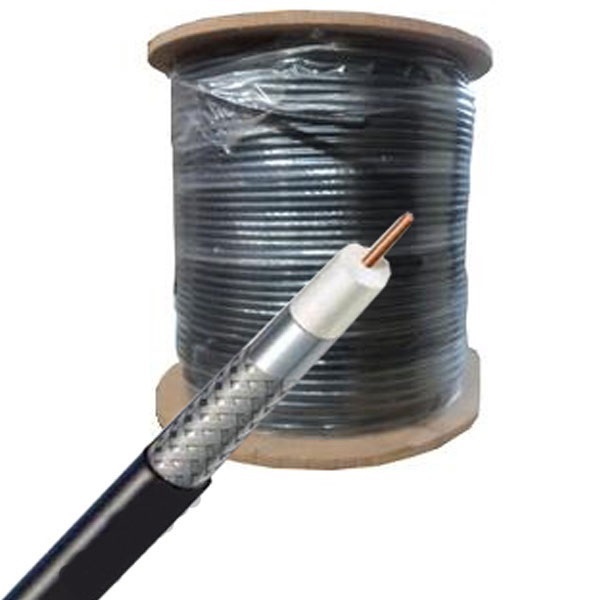 | Polycab Co-Axial Cables Polycab coaxial cable is a type of cable designed for transmitting high-frequency electrical signals, commonly used in cable television (CATV) and... View product → |
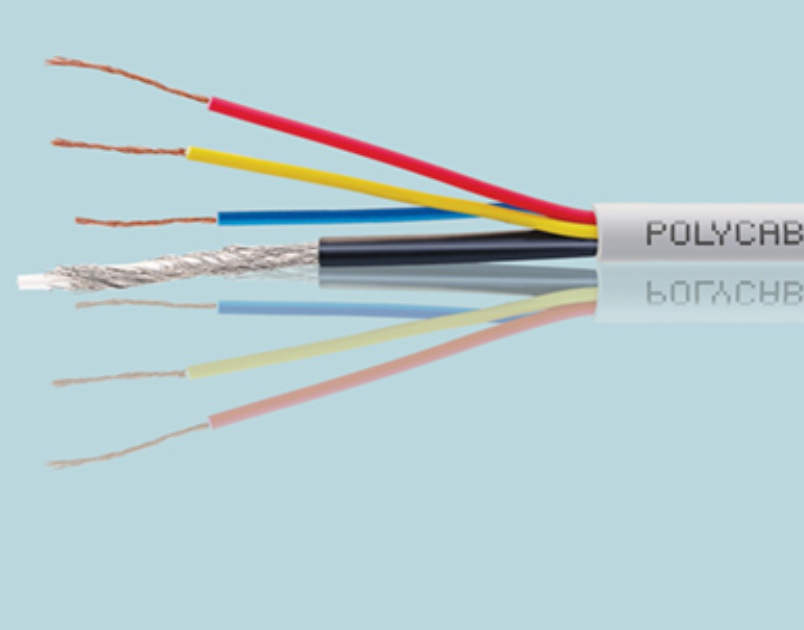 | Polycab CCTV Cables Polycab CCTV cables are specifically designed for use in closed-circuit television (CCTV) systems, offering reliable video signal transmission and... View product → |
Frequently asked questions
Does Polycab CCTV cable differ from Polycab coaxial cable?
Both can carry a 75-ohm video signal, but the finished cable may differ in shielding, construction, power conductors and termination. Compare the datasheet instead of relying on the product name.
How should you select cable for a Bengaluru CCTV installation?
Match the cable to the camera system—CVBS, HD-TVI, AHD or HD-CVI—then assess route length, indoor or outdoor exposure, interference sources and whether video and power share one cable.
Which cable specifications determine signal quality and usable distance?
Check 75-ohm impedance, attenuation at the operating frequency, conductor size, shielding coverage and the manufacturer’s stated transmission distance for your video format.
Which connectors and protection details prevent installation faults?
Use connectors designed for the cable diameter and camera system, crimp or compress them correctly, maintain the shield through the termination and seal outdoor joints against moisture.
What should you ask a Polycab dealer for before placing the order?
Ask for the exact product code, datasheet, conductor and shield details, supported distance, pack length, batch information, connector compatibility and guidance for indoor or outdoor installation.