A building’s height does not determine whether you need 1.5 sq mm, 10 sq mm or a much larger cable. You will need the load calculation, installation conditions, fire-performance requirement and approval documents before asking a Hyderabad supplier for a technically valid Polycab quotation.
Key takeaways
- Specify voltage, conductor metal, cores, insulation and installation method.
- Calculate design current before selecting feeder, riser or final-circuit size.
- Compare copper, aluminium, LT and HT cables against load and route length.
- Request test certificates, datasheets and approvals before ordering Polycab cables.
What qualifies as a high-rise cable for a building project?
“High-rise cable” is not a complete cable classification or ordering specification. Specify the voltage grade, copper or aluminium conductor, nominal cross-section, number of cores, conductor class, insulation, sheath, armouring and installation method before requesting Polycab highrise cable options.
| Construction | What it does | What it does not prove |
|---|---|---|
| FR | Limits flame spread | Low smoke or circuit survival |
| FRLS | Limits flame spread and reduces smoke | Zero halogen or fire-survival performance |
| LSZH | Limits halogen-acid gas emission | Circuit operation during fire |
| Fire-survival | Maintains circuit operation for a specified test duration | Survival of an incompatible installation system |
Fire-survival performance belongs to the complete circuit, not the cable alone. Confirm compatibility of joints, glands, cleats, trays, supports and terminations; an ordinary PVC accessory can fail while the cable remains intact.
Check the datasheet and tender for:
- Insulation rating and sheath material
- Conductor operating temperature
- Smoke emission and acid-gas emission limits
- Specified circuit-integrity duration
- Voltage designation, conductor class, core count and armouring
- Installation method and required accessories
Match the exact construction to IS 694, IS 7098 Part 1 or IS 17048, as applicable, and request the manufacturer’s test certificate for that exact construction. CPR or an equivalent classification belongs in the specification only when the project calls for it. A riser location alone does not justify a fire-survival or LSZH cable.
How do you calculate cable size for a Hyderabad high-rise?
Start with the load, not the building height. A quotation request for cable dealers polycab highrise cable sizes in hyderabad is incomplete until the electrical design produces a traceable calculation.
1. Establish the connected load, convert it to demand load using the approved demand and diversity factors, then calculate design current. For three-phase supply, use I = kW × 1,000 ÷ (√3 × system voltage × power factor).
2. Select the permitted voltage-drop limit from the project specification. The familiar design conventions are 3% for lighting and 5% total voltage drop, but they are not universal rules; the approved project limit governs.
3. State the calculation inputs: system voltage, power factor, copper or aluminium conductor, insulation temperature rating, ambient temperature, installation method, tray or shaft grouping, ventilation and vertical run length.
4. Check continuous current capacity after applying temperature, grouping and installation corrections. A riser shaft cannot use a free-air single-cable rating: grouped loaded circuits add heat in a confined space. A long riser also increases voltage drop and pulling tension.
5. Check prospective short-circuit current for the specified protective-device clearing time, then confirm protective-device coordination. A cable that passes the load check can still fail the fault withstand check.
6. Install single-core AC cables in trefoil or an approved flat formation, using suitable non-ferromagnetic glands, cleats and supports. For parallel runs, match material, size, length, route, insulation and terminations so current divides correctly.
Which conductor size fits a feeder, riser or final circuit?
A 118 A load does not automatically mean a particular cable size. Take a three-phase 415 V feeder with a calculated design current of 118 A, a 65 m one-way riser, a designer-specified 3% voltage-drop limit and a 0.2-second fault-clearing time.
Test each candidate for corrected ampacity after grouping and temperature derating, voltage drop over 65 m, and adiabatic short-circuit withstand.
A cable that passes the current table can still fail the riser calculation. If the smallest ampacity-compliant option exceeds the permitted voltage drop or its short-circuit withstand is below the prospective fault energy, move to the next cross-section or redesign the arrangement. Use the actual shaft ventilation, tray formation, loaded circuits and protective-device data.
| Comparison point | Typical circuit comparison | Decision condition |
|---|---|---|
| 1.5 sq mm | Lightly loaded lighting or control | Use only when load, voltage drop and protection permit |
| 2.5 sq mm | Socket or small-power circuit | Confirm continuous current and installation derating |
| 4 sq mm or 6 sq mm | Larger final circuit | Confirm load, route length and fault withstand |
| 10 sq mm or larger | Submain or feeder | Use only when the calculation supports it |
These are comparison points, not automatic applications. A 90°C XLPE rating does not justify a smaller cable than a 70°C PVC-based design: terminals, grouping, ambient temperature, fault duration and the product standard still govern. Compare polycab highrise cable options through a polycab highrise cable dealer in hyderabad using the approved calculation, not building height.
When should you choose copper, aluminium, LT or HT cable?
Copper is the safer default for smaller vertical circuits: it has lower resistance at the same nominal cross-section, needs compact terminations and is easier to handle.
Aluminium reduces cable weight and material cost, but often needs a larger size, careful surface preparation, correctly rated glands, torque-controlled terminations and bi-metallic lugs where copper and aluminium interfaces differ.
| Option | Main advantage | Decision point |
|---|---|---|
| Copper LT | Lower resistance and compact terminations | Smaller circuits, tight shafts or limited terminal space |
| Aluminium LT | Lower weight and material cost | Larger feeders when shaft space, lugs and installation labour remain acceptable |
| LT feeder | Operates at the building’s low-voltage supply and equipment rating | Use for normal vertical distribution within the LT system |
| HT cable | Connects a medium-voltage intake to transformer equipment | Use only with HT switchgear, protection, clearances, transformer and utility approvals |
Do not treat HT cable as a replacement for an oversized LT riser. Compare total installed cost, including tray space, drum weight, pulling tension, joints, lugs, glands, termination labour and equipment.
Before choosing one large multi-core run, check its minimum bending radius, shaft width, pulling equipment, support spacing and drum weight. Several smaller parallel runs can simplify handling, but require identical material, size, length, route, insulation and terminations so current divides correctly.
A highrise cable supplier in Hyderabad should match the quotation to those installation constraints, not only the cable price.
What should you request from a Polycab cable dealer before approval?
Request a quotation that can be checked against the approved cable schedule, not a generic “high-rise cable” description. Use this procurement checklist:
1. Ask for the exact Polycab product datasheet, applicable Indian Standard, voltage designation, conductor class, conductor material, nominal cross-section and core count.
2. Confirm the insulation and sheath compound, armouring, current rating under the stated installation conditions, outer diameter, minimum bending radius, drum length and delivery construction, including whether the supply is single-core or multicore and armoured or unarmoured.
3. Request the manufacturer’s test certificate for the exact cable construction and size. A certificate for a similar product family does not prove that the quoted cable meets your schedule.
4. At receipt, reconcile the drum label, batch or manufacturing details, printed cable marking, supplied length and invoice against the approved schedule. Do not accept visual drum approval or a generic invoice as traceability evidence.
5. Require the project engineer to approve any substitution from a standard stock size. Before acceptance, check ampacity, voltage drop, short-circuit withstand, tray fill, gland size, fire performance and termination compatibility.
A highrise cable supplier in hyderabad may offer a nearby available size, but availability does not make it technically interchangeable. A polycab highrise cable dealer in hyderabad such as Prabhat Cables Pvt. Ltd can support document matching and genuine-product sourcing; the electrical designer remains responsible for sizing and approval.
Related product
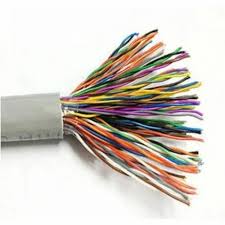 | Polycab Highrise Cables Polycab Highrise Cables are a range of wires and cables specifically designed for use in high-rise buildings, prioritizing safety and performance in... View product → |
Frequently asked questions
What qualifies as a high-rise cable for a building project?
High-rise cable is not a complete classification. Specify the voltage grade, copper or aluminium conductor, nominal cross-section, number of cores, conductor class, insulation, sheath, armouring and installation method.
How do you calculate cable size for a Hyderabad high-rise?
Start with the design load and voltage, calculate design current, then check ampacity, voltage drop, short-circuit withstand, grouping, ambient temperature and the installation route.
Which conductor size fits a feeder, riser or final circuit?
Select each size from its calculated design current and installation conditions. A feeder or riser needs checks for demand, voltage drop and fault withstand; a final circuit also needs coordination with its protective device.
When should you choose copper, aluminium, LT or HT cable?
Choose copper or aluminium after comparing current capacity, route length, termination requirements, weight and cost. Choose LT or HT according to the system voltage and the equipment receiving the supply.
What should you request from a Polycab cable dealer before approval?
Request the product datasheet, exact construction details, voltage grade, conductor size, drum identification, test certificates, applicable compliance documents and a written quotation matching your project specification.