A festoon cable must survive repeated travel, not just carry the required current. By checking the motion system, cable dimensions, electrical load, environment, datasheet and supply documentation, you can decide whether local purchasing reduces commissioning risk or merely provides a faster but less traceable replacement.
Key takeaways
- Use festoon cable for supported loops travelling with cranes, hoists or moving machines.
- Measure travel length, loop depth, trolley spacing and power requirements before requesting quotes.
- Match conductor count, voltage, bending radius, sheath and temperature range to the installation.
- Ask a local Ahmedabad supplier to verify stock, datasheet details and delivery before approval.
Confirm that the motion system needs festoon cable
Choose festoon construction when the cable hangs in supported loops from trolleys and travels with a crane, hoist or other moving machine. The loop path is defined, and the cable flexes during every equipment movement rather than only during installation.
| Cable type | Mechanical arrangement | When it applies |
|---|---|---|
| Festoon cable | Suspended loops carried by trolleys | Repeated crane, hoist or trolley travel |
| Standard flexible cable | Fixed installation with occasional repositioning | Not repeated dragging through trolleys |
| Drag-chain cable | Guided energy chain with controlled bend geometry | Machines fitted with an energy chain |
| Trailing cable | Unsupported or floor-travel arrangement | Equipment that pulls or drags cable across a surface |
A standard flexible cable can develop conductor fatigue, sheath cracking or deformed loops when trolley movement repeatedly loads it. A drag-chain cable belongs inside its specified chain, while a trailing cable is designed for a different unsupported or floor-travel path.
Count actual movement cycles, travel speed and direction changes. A cable moving hundreds of times per shift faces a different duty from wiring moved once during maintenance.
Confirm that the proposed Polycab festoon cable is identified for festoon, crane, hoist or trolley service. Ask a Polycab dealer for the exact datasheet and dynamic bend-radius information. Electrical compatibility alone does not prove mechanical suitability.
Measure the system before asking for a quotation
Record the system before asking for a quotation; a cable with the right voltage can still jam, stretch tight or drag on the floor.
| Measurement | Record | Why it matters |
|---|---|---|
| Conductor layout | Core count, cross-section in mm², rated voltage, and power, control, brake, encoder and protective-earth assignments | Prevents overload and wiring errors |
| Cable geometry | Width, height, loop length, trolley spacing and hanging arrangement | Matches rollers, clamps and loop clearance |
| Motion data | Full travel length, operating speed and minimum dynamic bend radius | Confirms repeated-flexing suitability |
Do not use a spare core as a replacement for a shielded control pair. That substitution can create encoder interference or control faults. Ask a polycab cable supplier for the exact datasheet, including the dynamic bend radius and permissible travel conditions.
Calculate the order length from:
- Full travel distance
- Cable retained in the loops
- Reserve at the control panel
- Reserve at the machine connection
- Allowance for both end terminations
- Additional loop depth created by the trolley spacing
Add these figures, then check that the cable does not pull tight when the machine reaches either end. Excess length is not harmless: a deep loop can reach the floor, rub against another loop or overload the trolleys.
Give any polycab dealer festoon cable in ahmedabad a simple installer sketch showing the fixed ends, moving end, trolley positions, loop depth and termination points. The sketch lets the supplier check cable width and height against the hardware before issuing a quotation.
Match cable geometry and construction to the site
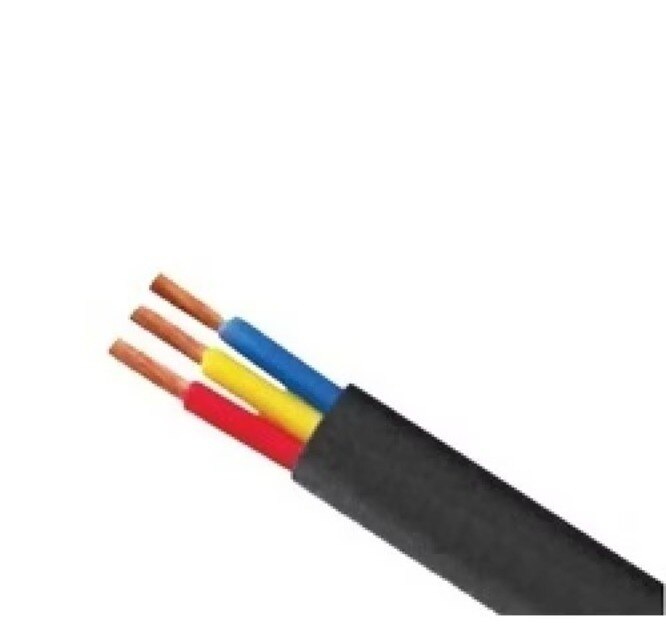
A flat cable works only when its width, thickness and orientation match the existing trolley rollers, clamps and hanger spacing. Twisting it or letting it roll onto its edge causes rubbing, uneven loops and premature sheath damage.
Use this site checklist before approving a Polycab festoon cable:
- Compare the flat cable’s width and thickness with the roller groove, clamp opening, loop depth and adjacent-loop clearance. A round cable may suit another clamp or bending path, but it often needs more clearance and different termination work.
- Measure the smallest dynamic bend radius created when the trolley changes direction or reaches either end of travel. Do not rely on the larger radius permitted for storage.
- Separate installation flexibility from flex-life. A cable that bends easily by hand can still fail after thousands of travel cycles if its construction is not rated for repeated festoon movement.
- Match the sheath to the site. Clean indoor service may suit one construction; rain, oil, dust, welding sparks, chemicals, abrasion, outdoor temperature changes or low temperatures require the manufacturer’s stated resistance claims.
- Support the cable in its intended orientation. Keep it off the floor and away from sharp edges and pinch points; tight clamps at flexing points concentrate stress.
- Use strain relief at both terminations and confirm that the end fittings accept the selected cable geometry.
Ask a festoon cable dealer in Ahmedabad for the exact dynamic bend radius, permissible travel conditions and sheath specification. Do not approve a Polycab festoon cable from its brand name alone.
Read the exact datasheet before approving the cable
Approve the quoted cable only after the exact datasheet proves that its electrical and mechanical ratings cover the complete installation. A family brochure is not enough.
1. Request the datasheet for the exact model and conductor size from the polycab dealer. Check conductor class, core count, cross-section, insulation material, sheath material, rated temperature or operating-temperature range, voltage rating, minimum dynamic bend radius, permissible travel or flexing conditions, flame-retardant or low-smoke properties, and the IS or IEC standard stated for that construction.
2. Calculate ampacity from the number of simultaneously loaded cores, ambient temperature, grouping inside the festoon system, installation position and duty cycle. Include power, brake, control and earth cores when they carry current; a single-conductor rating cannot represent the complete cable.
3. Check voltage drop across the full crane or hoist travel, especially on long, low-voltage motor runs. A cable that meets ampacity can still cause motor undervoltage at the far end.
4. Compare the specified dynamic bend radius with the tightest loop created when trolleys change direction or reach end travel. Ask for flexing-cycle information when failure would stop production, and do not substitute a static storage radius.
5. Require the quotation from any polycab cable supplier to identify the manufacturer part number, batch or lot, manufacturing date where provided, original packing, invoice and available routine or conformity test documentation. Do not infer a rating from the Polycab name alone.
Decide when a local Ahmedabad purchase lowers risk
Local buying lowers risk only when it removes a commissioning uncertainty, not merely a day of transit. Choose an Ahmedabad source for a short cut length, urgent replacement, matching trolleys or termination accessories, or a physical comparison with the cable already installed.
A factory-sealed full-length cable with traceability remains safer for a critical crane when the local offer is an unidentified cut length.
Before accepting a quotation, use this purchase check:
1. Verify the seller through Polycab’s current channel or dealer-verification route. The search terms “polycab dealer festoon cable in ahmedabad” and “festoon cable dealer in ahmedabad” do not prove authorised status.
2. Request the exact manufacturer part number and datasheet. Confirm conductor class, core count and cross-section, voltage, insulation and sheath, temperature range, minimum dynamic bend radius, flexing or travel conditions, and applicable IS or IEC standard.
3. Match the delivered marking, original packaging and purchase order. Check manufacturer, cable type or part number, core count, conductor cross-section, voltage, length and required standard mark; record batch or lot, manufacturing date where provided, invoice identity and routine or conformity test documents.
4. Reject a generic description such as “Polycab crane cable.” Resistance testing or visual measurement can reveal a substitution, but cannot prove dynamic flex suitability.
Prabhat Cables Pvt. Ltd is worth considering when it can supply that identification alongside the cut length or accessories your installation needs. A local polycab cable supplier earns preference when documentation and physical fit reduce acceptance and commissioning risk.
Related product
 | Polycab Festoon Cables Polycab Festoon Cables are specialized flat, flexible cables designed for use in festoon systems, particularly on cranes, hoists, and lifts. View product → |
Frequently asked questions
How do you confirm that a system needs festoon cable?
Choose festoon construction when the cable hangs in supported loops from trolleys and travels with a crane, hoist or other moving machine. The cable flexes during each equipment movement.
What should you measure before requesting a festoon cable quotation?
Record the travel length, loop depth, trolley spacing, cable route, conductor count, conductor cross-section, operating voltage and equipment movement speed.
Which cable construction details must you compare?
Compare conductor count and size, insulation and sheath materials, overall diameter, minimum bending radius, temperature range, voltage rating and resistance to oil, abrasion and outdoor exposure.
Why read the exact Polycab festoon cable datasheet before approval?
Use the datasheet to confirm the cable designation, conductor arrangement, electrical ratings, minimum bending radius, operating temperature and environmental suitability against the measured installation.
When can buying from an Ahmedabad festoon cable dealer lower risk?
A local purchase can simplify site clarification, stock checks, delivery coordination and replacement planning when the installation is in Ahmedabad or nearby.