Choose an armored LT cable when the route exposes the cable to burial pressure, impact, rodents, weather or industrial handling—not simply because the cable will carry power below 1,100 V. By the end, you will be able to specify the construction, calculate its usable capacity, check the installation accessories and decide when a specialist dealer is worth choosing over a general wholesaler.
Key takeaways
- Use armour for direct burial, exposed routes, or likely mechanical impact.
- Match conductor size, insulation, voltage rating, and armour to the route.
- Verify voltage drop, current capacity, short-circuit withstand, and installation derating.
- Ask the dealer for datasheets, test certificates, batch details, and genuine supply records.
When does an LT cable route actually need armour?
Direct-buried, exposed, or impact-prone routes usually justify armour; a cable inside a correctly sized conduit, duct, or protected tray may not.
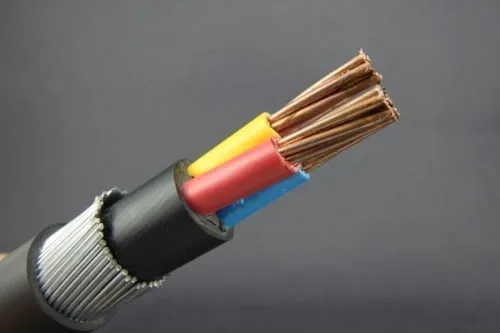
The construction has three protective layers: an inner sheath surrounds the insulated cores, metallic armour resists crushing, cuts, impact and rodent damage while providing an earthing or fault-current path when designed for that purpose, and the outer sheath seals the assembly against moisture, abrasion and the surrounding environment.
Specify armour when the route includes:
- Direct burial without a continuous protective duct
- Outdoor runs exposed to sunlight, falling objects, water or accidental impact
- Industrial areas with machinery, construction activity or vehicle movement
- Rodent exposure or access by untrained personnel
Choose an unarmored polycab low tension cable when the route is fully protected and the conduit, duct or tray is sized, supported and sealed for the cable. Armour adds diameter, weight, bending effort and termination work; it is not automatically the better choice.
“Armored” does not mean fire-resistant, low-smoke, halogen-free, water-blocked, or suitable for chemical and hazardous environments. For wet, buried or outdoor installation, check the declared sheath resistance to moisture, hydrocarbons, sunlight and flame propagation.
Ask a polycab armored cable dealer to quote the actual voltage designation, such as 0.6/1 kV or 0.6/1.1 kV, rather than relying on the trade term LT cable.
Which cable construction matches the load and route?
Match the route and load before choosing a Polycab LT cable: armour type, conductor material and insulation must fit the installation rather than the product label.
| Option | Mechanical protection | Best fit |
|---|---|---|
| Steel wire armour | Stronger resistance to impact and pulling damage | Direct burial, exposed routes and industrial areas |
| Steel tape armour | Protection against crushing and general mechanical contact | Fixed buried or protected installations with lower impact risk |
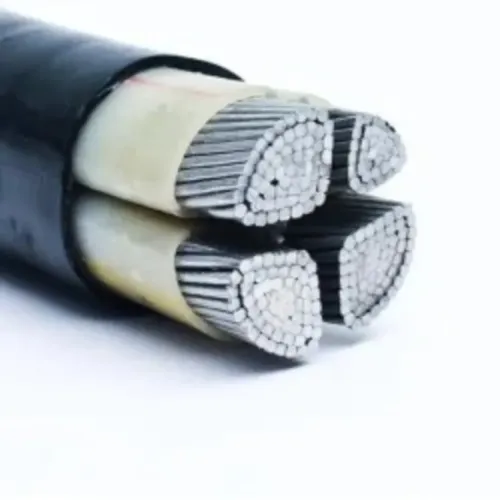
| Nonmagnetic aluminium armour | Avoids magnetic losses in single-core AC circuits | Single-core feeders where steel armour could cause induced-current heating |
For a single-core AC circuit, obtain a magnetic-loss calculation before accepting steel armour. Specify nonmagnetic aluminium armour or another approved construction when the calculation requires it.
Copper offers compact terminations; aluminium needs a larger cross-sectional area for the same duty. Use aluminium-rated connectors, lugs and joint compounds suited to the conductor class. Copper-only lugs are not interchangeable.
Put these details on the quotation:
- Conductor material and class
- Nominal cross-sectional area
- Number of cores
- Rated voltage, such as 0.6/1 kV
- XLPE or PVC insulation
- Sheath material
- Applicable Indian Standard
Use IS 7098 (Part 1) for XLPE-insulated cables up to and including 1,100 V, or IS 1554 (Part 1) for PVC-insulated heavy-duty cables up to and including 1,100 V. Ask a Polycab armored cable dealer to state the standard, not merely “armoured LT cable,” so the delivered construction can be checked against the order.
How do you prove the cable size will work on site?
A cable that carries the load on paper can still overheat or deliver inadequate voltage at the equipment. Prove the selected Polycab LT cable against the actual route, not the generic ampacity printed on a Polycab low tension cable label.
1. Request the manufacturer’s ampacity table with its assumptions. Check conductor material and cross-sectional area, conductor class, and installation in air, tray, conduit or ground. Apply corrections for ambient or soil temperature, grouping, burial depth and soil thermal resistivity. A table value without these conditions is not a site rating.
2. Coordinate the cable with its protective device. Compare continuous cable capacity with the settings and rating of the MCB, MCCB, fuse or motor starter, then check the prospective fault current and disconnection time. A correctly sized breaker does not make an undersized cable safe.
3. Calculate voltage drop for the complete route. Use route length, operating current, starting current and the permissible voltage drop for the equipment. Request conductor resistance or voltage-drop data at operating temperature, especially for long feeders, motor starting, and low-voltage lighting or control circuits. A larger conductor can be necessary even when thermal ampacity passes.
Before approving the size, record the route length, installation method, grouping, ambient or soil conditions, motor starting current and allowed voltage drop. Obtain those calculations with the quotation; do not approve a Polycab LT cable from nominal area alone.
What installation checks decide whether armour will perform?
Armour performs only when the cable, route and termination are compatible. Check direct burial, trays, ducts, wet areas, sunlight, coastal humidity, salt, hydrocarbons, chemicals and high-temperature locations before approving the drum.
1. Match the cable to the environment. Chennai’s high ambient temperature and solar exposure can reduce ampacity and demand a suitable outer sheath; coastal salt and water ingress can damage unsuitable sheaths and gland seals. Confirm burial depth, drainage, duct condition, grouping and storage protection.
Do not assume armour alone makes a cable waterproof, chemical-resistant or suitable for hydrocarbons.
2. Select the termination from the finished cable, not its conductor size. Measure the actual outer diameter and identify the armour type before ordering the gland. Use compatible locknuts, earth tags or an equivalent bonding arrangement; the wrong gland can leak, damage the sheath or leave armour continuity unreliable.
3. Prove the earthing path. Armour is not automatically the protective earth. Use it only when continuity and fault-current calculations demonstrate adequate cross-sectional area; otherwise install a separate protective conductor. Check this separately from cable ampacity, which depends on conductor size, installation method, temperature, grouping and soil conditions.
4. Inspect every marking before installation. Confirm manufacturer, voltage grade, core count, conductor size and material, applicable standard, batch or manufacturing information and length. Quarantine missing or inconsistent markings, and ask a Polycab armored cable dealer or LT cable dealer in Chennai to resolve them before termination.
When is a specialist Polycab dealer worth choosing?
Choose a specialist when the seller can prove that the exact cable specified in your design is the cable delivered, tested and installed. A Polycab armored cable dealer should preserve that identity from quotation through drum acceptance, not merely offer a lower metre rate.
| Seller type | Evidence you receive | Main risk |
|---|---|---|
| Authorised Polycab armored cable dealer | Manufacturer-linked drum details, routine-test records and matching accessories | Lower risk of substitution or incomplete documentation |
| General electrical wholesaler | Invoice and generic product description | Construction, origin and test evidence may be difficult to establish |
| Unverified reseller | Price claim without traceable records | Wrong size, length or construction may reach termination |
Put every drum into the purchase file with its manufacturer marking, batch or drum number and factory routine-test records. Ask for conductor resistance, high-voltage withstand, insulation resistance where applicable, and dimensional results; a certificate for another cable proves nothing.
Inspect the drum before acceptance. Compare its printed designation with the purchase order and quarantine it if any of these details are missing or inconsistent:
- Core count and cross-sectional area
- Voltage designation and applicable standard, such as IS 7098 (Part 1) or IS 1554 (Part 1)
- Conductor material, batch number and actual cable length
Require the quotation to separate total cable length from individual drum length, state permitted length tolerance, and show drum dimensions, gross weight and lifting restrictions. A capable Polycab armored cable dealer for LT cable in Chennai can also coordinate correctly sized glands, aluminium-rated or copper-rated lugs, test documents, delivery timing and shortage or replacement handling.
That is where an lt cable dealer in chennai such as Prabhat Cables Pvt. Ltd adds value: controlled traceability and installation support, not just a quoted number.
Related product
 | Polycab LT Cables Polycab LT (Low Tension) cables are a type of electrical cable designed for the transmission of electrical power at low voltages, typically below... View product → |
Frequently asked questions
When does an LT cable route need armour?
Choose an armored LT cable for direct burial, exposed runs, or routes vulnerable to impact. A correctly sized conduit, duct, or protected tray can remove the need for armour.
How do you select the right Polycab LT cable construction?
Match conductor material and size, insulation type, voltage grade, number of cores, armour construction, and sheath to the load and installation route.
How can you prove an LT cable size will work on site?
Check design current, allowable ampacity, voltage drop, short-circuit withstand, grouping, ambient temperature, installation method, and route length against the manufacturer’s datasheet.
What should you check when buying from a Polycab armored cable dealer?
Request the product datasheet, applicable test certificates, drum label, batch or manufacturing details, cable length, and proof that the supply is genuine and suitable for your project.