Choosing an HT cable is not a matter of matching a price to “11 kV” or “33 kV.” You need to align the system voltage, U₀/U rating, conductor, insulation, screen, installation conditions, fault duty, accessories and delivery documents before comparing offers from suppliers in Raipur.
Key takeaways
- Choose HT cable for systems above 1 kV and match the actual system voltage.
- Compare conductor size, insulation, screen, core arrangement and route conditions.
- Request routine test reports, accessory details, delivery dates and drum identification.
- Check GST, freight, testing, warranty and installation scope before accepting a quotation.
When an HT cable is the right choice, and how voltage grades differ
Choose HT cable when the circuit operates above 1 kV; an LT cable does not provide the insulation screening, accessories or earthing design needed for that electrical stress. Match the cable to the actual system voltage, not merely the transformer or feeder label.
| Cable grade | Comparison point | Typical use |
|---|---|---|
| 3.3 kV | Medium-voltage system | Motors, industrial feeders |
| 6.6 kV | Higher motor and feeder voltage | Plants and substations |
| 11 kV | Common distribution grade | Utility and industrial networks |
| 22 kV | Higher distribution voltage | Regional feeders |
| 33 kV | Primary distribution | Substations and long feeders |
| Above 33 kV | Special insulation coordination | Transmission and large substations |
For an 11 kV three-phase system, a suitable designation may be 6.35/11 kV: U₀ is conductor-to-earth voltage and U is conductor-to-conductor voltage. Check the complete U₀/U(Um) notation, especially for 22 kV, 33 kV and higher systems. Earthing arrangements change insulation coordination, so an “11 kV” quotation can still have the wrong U₀.
Ask a Polycab distributor for these documents when comparing Polycab HT cables in Raipur:
- The stated voltage grade, maximum system voltage Um and earthing basis
- Compliance with IS 7098 (Part 2) and the project utility specification
- IEC 60502-2 evidence for international requirements; it does not alone prove Indian BIS or utility acceptance
- Matching termination and joint details for the exact cable construction
What cable construction and core arrangement should you compare?
Compare conductor material and cross-sectional area first; aluminium reduces weight and purchase cost, while copper carries more current for the same area. Then compare the construction, because identical voltage and conductor area do not guarantee identical ampacity, dimensions, losses or accessory fit.
| Arrangement | Strength | Design checks |
|---|---|---|
| Single-core | Suits high-current transformer connections, substations and engineered routes | Check induced currents, magnetic effects, cleat spacing, phase spacing and screen bonding |
| Three-core | Provides a compact feeder for industrial plants, substations and underground routes | Confirm bending radius, pulling method, termination kits and available joint accessories |
Record each construction detail in the offer:
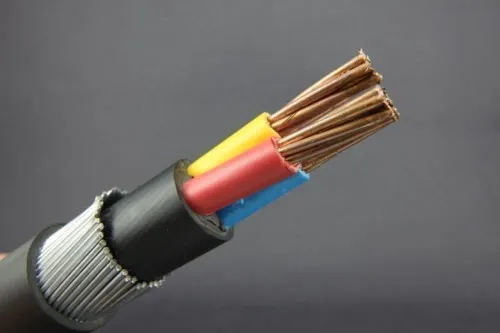
- Conductor screen, XLPE insulation thickness and insulation screen; differences alter electrical stress control and insulation diameter.
- Metallic screen material, cross-sectional area, permissible short-circuit current and duration; it provides earthing, fault-current capacity and electromagnetic shielding.
- Bedding or inner sheath, armour type and outer-sheath material; these change diameter, weight, bending radius, termination compatibility and ampacity.
- Longitudinal or radial water blocking; specify it for ducts, direct burial, wet soil or routes where sheath damage could allow moisture migration.
Compare single-point, both-end and cross-bonded screen earthing. Each produces different sheath voltage and circulating-current losses, so the bonding method and link boxes must match the ampacity calculation.
An enquiry to a Polycab distributor HT cable in Raipur should identify these fields, not merely “11 kV cable.” When comparing Polycab HT cables in Raipur, treat 3-core and single-core offers as different cable systems, not interchangeable price options.
How to size the conductor, insulation and screen for the route
Start with design load current, motor starting current, cyclic loading, permissible voltage drop, prospective short-circuit current and clearing time. Do not select the largest catalogue conductor or copy a free-air rating.
| Conductor | Cost and installation effect | Check before choosing |
|---|---|---|
| Aluminium | Lower purchase cost and drum weight | Lug compatibility, larger diameter, losses and voltage drop |
| Copper | Higher conductivity and smaller cross-section | Lugs, glands, termination labour, handling and total installed cost |
Apply the route conditions to the manufacturer’s rating:
- Direct burial, duct, tray or tunnel
- Ambient air or soil temperature
- Soil thermal resistivity and burial depth
- Grouping, spacing and parallel circuits
- Single-point, both-end or cross-bonded screen arrangement
For a Raipur project, obtain the assumed soil thermal resistivity and seasonal design condition. A generic catalogue ampacity can overrate a buried cable.
Confirm continuous current capacity after derating, then verify conductor and metallic-screen short-circuit withstand separately. The screen needs its material, cross-sectional area, fault-current capacity and bonding method specified; it provides earthing and shielding.
XLPE supports a higher operating-temperature design and less routine maintenance than paper-insulated cable, but contaminated preparation or incompatible joints and terminations can cause failure. Specify conductor diameter, insulation diameter and screen design before ordering accessory kits.
Ask a polycab distributor or HT cable dealer in Raipur to match every kit to those dimensions, the voltage grade, armour treatment and earthing method.
Which tests, accessories and delivery controls protect the installation?
A technically correct cable can fail during jointing or pulling if its accessories and route plan do not match the exact construction. Match each termination and joint to conductor size, insulation diameter, voltage grade, screen arrangement, armour treatment and earthing method; nominal conductor size alone is insufficient.
Obtain the manufacturer’s maximum pulling tension, sidewall pressure, minimum bending radius and installation-temperature limits for the specified cable. Tight bends, several manholes or a long duct pull can require rollers, intermediate pulling points, a revised drum plan or a different route.
| Test category | What to request | What it proves |
|---|---|---|
| Routine | Conductor resistance, partial discharge and high-voltage records | The delivered drum passed production checks |
| Type | Complete report for the proposed construction | The design family passed qualification tests |
| Sample or special | Tests stated separately in the offer | Additional agreed verification |
For HT XLPE cables, partial-discharge records must show the test standard, test voltage, measured result or acceptance criterion, cable identification and drum number. A routine certificate for one drum is not a type-test report for every construction.
Before unloading Polycab HT cables in Raipur, inspect:
- Drum number, cable length, voltage grade and conductor size
- Manufacturing date and end seals
- Outer sheath for cuts, crushing or other visible damage
A damaged cap or unsealed end can admit moisture. A short drum can force an unplanned joint, adding failure risk and installation cost.
How to compare a Raipur distributor’s HT cable quotation
Put the enquiry in writing before asking for a rate. State the system voltage and earthing arrangement, U₀/U(Um) rating, conductor material and area, number of cores, route length, installation method, screen and armour requirements, required delivery length and accessories.
- Ask for XLPE insulation, insulation thickness, metallic-screen construction, inner sheath, armour, outer-sheath material and water-blocking details.
- Request the quoted delivered drum length, freight, unloading, taxes, testing, wastage allowance, joints, termination kits, replacement lead time and warranty response.
- Require IS 7098 (Part 2) marking, manufacturer-linked confirmation, serial or drum traceability, sealed test records and written warranty terms.
A Polycab distributor should identify every construction difference between competing offers. For a search involving a Polycab distributor HT cable in Raipur or an HT cable dealer in Raipur, check these commercial differences:
| Offer item | Compare | Cost risk if missed |
|---|---|---|
| Drum supply | Delivered length, freight and unloading | Extra joints or handling |
| Cable construction | Aluminium or copper, cores, screen and armour | Incompatible kits, losses or higher labour |
| Quality documents | Drum-linked tests and traceability | Weak acceptance evidence |
| After-sales terms | Replacement lead time and warranty response | Extended outage |
A Polycab distributor in Raipur should confirm whether the drum is genuine, current production and covered by the intended warranty; its label alone proves none of these. Prabhat Cables Pvt. Ltd can help with a local business-to-business enquiry, but keep the purchase document-led.
An apparently cheaper 11 kV cable can cost more after freight, wastage, joints or delayed delivery.
Related product
 | Polycab HT Cables Polycab HT (High Tension) cables are designed for the transmission and distribution of electrical power at medium to high voltage levels, typically... View product → |
Frequently asked questions
When should you choose an HT cable instead of an LT cable?
Choose an HT cable when the circuit operates above 1 kV. Match its voltage grade to the system’s actual operating voltage, not only the transformer or feeder label.
Which HT cable construction details should you compare?
Compare the number of cores, conductor material and size, insulation type and thickness, metallic screen, armour, sheath, earthing arrangement and installation route.
How do you size an HT cable for a route?
Check continuous load current, short-circuit withstand, voltage drop, installation method, ambient and soil conditions, grouping, burial depth and allowable conductor temperature.
What should an HT cable quotation from a Raipur distributor include?
Ask for the exact cable specification, manufacturer and batch details, test reports, accessories, drum lengths, delivery schedule, freight, taxes, warranty and installation responsibilities.