A cable can pass a static electrical test and still fail when a trolley moves, a lift car travels, or a loop is repeatedly compressed. By the end, you will be able to identify whether the cable, installation, termination or support system caused the fault, test the failure properly, and verify a replacement before purchase.
Key takeaways
- Inspect the first repeatable damage point before replacing the cable.
- Check trolley alignment, bend radius, clamps and cable spacing.
- Test continuity and insulation while the festoon system moves.
- Match cable construction to travel distance, load and movement frequency.
Find the failure pattern before replacing the cable
A cable that fails at one repeatable point usually has a local mechanical cause, not a defective length of conductor. Inspect the failed section before ordering a replacement; the location, shape and type of damage reveal what happened.
1. Broken copper strands or a conductor that opens after repeated travel indicate bending fatigue, an excessive bend radius or a cable construction not rated for continuous flexing. Evenly distributed strand breaks along the travel path point to dynamic fatigue.
2. Cuts, polished sheath, exposed copper or white stress marks at the trolley entry indicate a sharp edge, pinch point or rubbing against steelwork. A flattened section indicates crushing by a clamp, roller or trapped loop.
3. Cracks in insulation or sheath, hardening, blistering and heat discolouration indicate overheating, ageing, chemical attack or an unsuitable temperature range. Oil-soaked rubber loses mechanical strength and can split during movement.
4. Kinks, twisted conductors, unstable loops, cable bunching or cage snagging indicate torsion, incorrect loop geometry or a round cable used where the carrier requires a flat festoon cable. The cable may rotate and cross over inside the trolley train.
5. Damage concentrated at a fixed termination indicates poor strain relief, excessive pull, terminal loosening or torsion transferred into the connection.
Photograph both sides of every failed section and record its distance from the trolley, clamp and end connection. This evidence is more useful than treating every Polycab rubber cable for festoon system problems as a cable-quality issue.
Separate cable damage from trolley and installation faults
A fault that returns at one location usually points to the equipment, not the cable. Inspect the whole travel path before ordering another replacement: a sharp trolley edge, seized guide roller, trapped loop, steelwork contact or excessive sag can reproduce Polycab festoon cable problems at the same point.
| Source | Telltale pattern | What to inspect |
|---|---|---|
| Cable construction or duty | Broken strands appear throughout the moving length, with evenly distributed fatigue, flattened sections or kinks | Confirm the cable’s stated festoon application, conductor class, bend radius and temperature range |
| Trolley or carrier | Sheath cuts, abrasion, pinching or cage snagging occur at trolley entries or between specific trolleys | Check trolley spacing, roller movement, sharp edges, loop clearance and cable bunching |
| Installation or termination | Damage repeats at the fixed end; conductors loosen, twist or break near the clamp | Check strain relief, clamp pressure, end alignment and whether termination transfers tensile load or torsion into the cores |
A round rubber power cable can also expose an equipment mismatch: it may rotate, cross over and form unstable loops in a carrier designed for flat festoon cable. Lay the cable without axial twist, then run the system slowly through its full travel.
- Record exposed copper, broken strands, insulation cracking, heat marks, oil contamination, cuts, white stress marks and terminal loosening.
- Mark each defect’s distance from the fixed end and compare it with trolley positions.
- Correct the mechanical cause before fitting a new cable; otherwise the same failure will return.
Diagnose intermittent faults while the system moves
Test the cable under movement, not only at rest. Isolate the circuit, disconnect connected equipment, and check continuity while slowly flexing the suspect section through the full travel. An open reading that appears at one trolley position identifies a broken conductor strand or loose termination.
A static insulation-resistance test can pass even when mechanically damaged strands are present. Repeat the insulation test while flexing the cable, then compare each core to earth and each core phase-to-phase; a falling or unstable reading points to cracked insulation, crushed sections or moisture contamination.
Use this sequence:
- Record continuity and insulation-resistance readings with the cable straight.
- Repeat both tests while moving the trolleys slowly from one end to the other.
- Mark the position where the reading changes, then inspect that point with power isolated.
- Compare all phases; one core with higher resistance, an open circuit or unstable insulation is significant.
| Finding during travel | Inspect first | Likely cause |
|---|---|---|
| Fault at trolley entry | Flattening, white stress marks, cuts and sheath compression | Tight bend, pinch or sharp trolley edge |
| Fault at fixed end | Terminal tightness, strain relief and cable rotation | Torsion or poor termination |
| Fault at one repeated position | Guide rollers, steelwork and trapped loops | Rubbing, snagging or cable bunching |
| Fault across the travel path | Exposed copper, broken strands and heat damage | Conductor fatigue or excessive bending |
Check for oil contamination and loosened terminals before replacing the cable. Repeated festoon cable faults at the same location usually return until the contact, clamp or trolley defect is corrected.
Match the cable to the movement, load and layout
Select the cable by movement first, then by current capacity. A cable with the correct cross-sectional area can still fail if its construction cannot survive the travel pattern.
| Option | Choose it when | Reject it when |
|---|---|---|
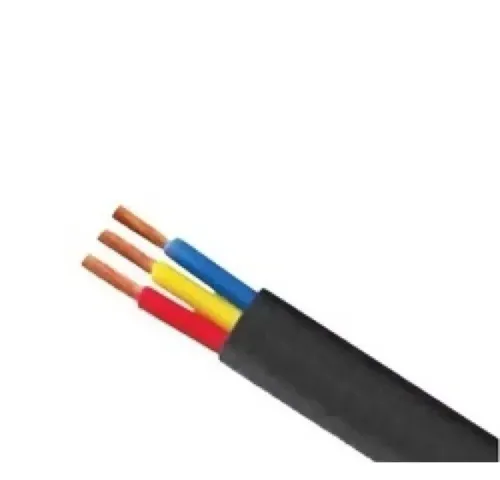
| Flat festoon cable | Trolleys carry the cable along a straight, supported festoon track, with the flat face held in the intended orientation | The route forces twisting, vertical suspension or uncontrolled looping |
| Round flexible rubber cable | The manufacturer specifically approves the product for repeated festoon movement and the installation prevents rotation between trolleys | It is described only as flexible rubber, or the cable will twist, kink or bunch during travel |
| Lift-duty cable | The cable hangs or travels in a lift system and must tolerate repeated suspension, controlled bending, torsion or lateral movement | The design details, travel height and suspension method have not been matched to the cable construction |
For a festoon installation, confirm trolley spacing, loop depth, travel speed, cable weight and the minimum dynamic bend radius. Install a round cable without axial twist; rotating the fixed end or paying it off a coil incorrectly can fatigue the conductors.
For a lift, give the supplier the travel height, suspension arrangement, counterweight layout, number of cycles and available shaft space. Do not replace lift-duty cable with general-purpose rubber cable because both use elastomeric insulation.
Check conductor class, voltage rating, temperature range, oil and water resistance, abrasion resistance and dynamic-use qualification. Oil, hydraulic fluid, cutting fluid, UV, welding spatter and abrasive dust can require a resistant sheath or added mechanical protection.
Verify the product and documents before ordering
Ask for the exact product code and supporting documents before comparing prices. “Polycab rubber cable” is not enough: a flexible cable for fixed installation or occasional movement can fail quickly in a festoon or lift.
1. Request the manufacturer’s datasheet showing conductor class, core count and size, voltage rating, temperature range, permitted bending radius and declared movement duty.
2. Check the drum label and catalogue against the quoted code. Record the applicable Indian or IEC standard and confirm that it covers the cable’s intended construction, rather than relying on a broad elastomer-insulated power-cable description.
3. Ask for written confirmation that the specific cable is suitable for festoon travel or lift suspension. For a lift, provide travel height, suspension method, counterweight arrangement and any torsion or lateral movement; a general-purpose rubber flexible cable is not an equivalent substitute.
4. Obtain the batch number or drum identification and the manufacturer’s routine test certificate. Match those details to the delivered drum before installation.
5. Disclose oil, hydraulic fluid, cutting fluid, UV exposure, welding spatter and abrasive dust. Request sheath compatibility or added mechanical protection when those hazards exist.
A Polycab rubber cable dealer in Pune, including Prabhat Cables Pvt. Ltd, should be able to identify the quoted code and provide this evidence; if the seller offers only a price and the word “rubber,” stop the order.
Related products
 | Polycab Festoon Cables Polycab Festoon Cables are specialized flat, flexible cables designed for use in festoon systems, particularly on cranes, hoists, and lifts. View product → |
 | Polycab Flexible Cables Polycab flexible cables are electrical cables designed with enhanced flexibility for various applications, including those involving movement,... View product → |
Frequently asked questions
How do you find the cause of a festoon cable failure?
Inspect the failed section for a repeatable damage point, then record its location, shape and damage type before replacing the cable.
How can you separate cable damage from trolley or installation faults?
Check trolley alignment, wheel condition, clamps, bend radius, cable spacing and obstructions before blaming the cable.
How do you diagnose an intermittent festoon cable fault?
Test continuity and insulation while the system moves through its full travel, and monitor the point where the fault appears.
How do you choose a rubber cable for a festoon system or lift?
Match the cable to travel distance, bend radius, moving load, movement frequency, operating environment and the installation layout.
What should you verify before ordering a replacement Polycab cable?
Confirm the exact product designation, size, conductor construction, voltage rating, sheath details, batch information and supporting documents.