A load value alone cannot determine the right LT cable: installation method, voltage drop, fault duty, heat, route conditions and termination details can change the selection. By following a documented process, your team can compare cable constructions, approve a precise technical submittal, inspect delivery and avoid ordering a cable that passes one calculation but fails another.
Key takeaways
- Calculate current, voltage drop and short-circuit withstand before selecting cable.
- Match conductor, insulation, cores and armour to the installation route.
- Check temperature, dust, water exposure and available space in Hyderabad conditions.
- Require approved datasheets, drum labels and test documents before installation.
Start with the load schedule, route survey and three cable calculations
Before approving a Polycab LT cable for projects, confirm the system voltage and match the cable to the actual installation, not the equipment name. The load schedule must show connected and demand loads, design current, motor starting current, power factor, phase arrangement, protective-device rating and future allowance.
The route survey must record length, tray, conduit, duct or buried installation, grouping, ambient temperature, soil conditions, bends, vertical runs, water exposure and termination space.
- Check continuous-current capacity after derating for ambient temperature, grouping, installation method and soil or enclosure conditions.
- Calculate voltage drop at design load over the full route, including motor or transformer starting performance where relevant.
- Check short-circuit withstand against the prospective fault current and protective-device clearing time.
Then confirm the system’s nominal voltage, earthing arrangement and fault level before ordering. State conductor material and size, core count, voltage grade, insulation, sheath, armour, drum length and applicable standard: IS 7098 Part 1 for XLPE 1.1 kV cables or IS 1554 Part 1 for PVC heavy-duty 1.1 kV cables.
Add named fire performance such as low-smoke, halogen-free, flame-retardant or fire-survival where the route demands it; “FR” alone proves nothing.
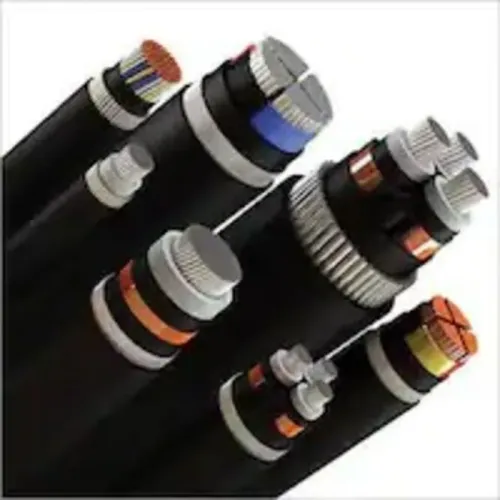
Choose conductor, insulation, cores and armour for the actual installation
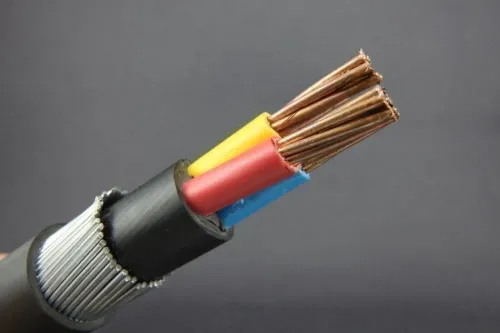
Approve the construction only after matching it to the route, termination hardware and fault duty. “Polycab LT cable” is not a complete specification; state 1.1 kV voltage grade, conductor class, insulation, cores, armour and sheath.
| Construction | Compare | Selection consequence |
|---|---|---|
| Copper, class-2 stranded | Lower resistance; higher material cost and weight | Useful where voltage drop, compact terminations or installation labour dominates |
| Aluminium, class-2 stranded | Lower cost and weight; needs compatible lugs, glands and jointing practice | Suitable for fixed feeders when termination workmanship is controlled |
| Class-5 flexible conductor | Easier bending; not a like-for-like replacement for class 2 | Use only where movement, tight bending or specified termination requires flexibility |
| XLPE insulation | Higher continuous and short-circuit temperature capability | Specify to IS 7098 Part 1 when the thermal and overload design needs it |
| PVC insulation | Lower temperature limits than XLPE | Specify to IS 1554 Part 1 where the calculated duty and environment permit it |
| Single-core or multicore | Single cores ease large-current installation; multicore simplifies smaller circuits | Match core count to phases, neutral, earth arrangement and pulling space |
| Unarmoured, steel-wire or steel-strip armoured | Armour changes mechanical protection, gland selection and earthing | Choose from route exposure, fault protection and enclosure details, not habit |
Put the selected construction, cross-sectional area, sheath, fire-performance requirement, drum length, applicable standard and test documents in the purchase order. Confirm that the gland, lug, earth tag and enclosure suit the armour before approval; identical conductor area does not make different constructions interchangeable.
Read the datasheet against Hyderabad’s heat, dust, water and space limits
A selected cable will work only when its datasheet limits survive the route’s temperature, moisture, dust, mechanical exposure and available space. Check the stated construction standard: IS 7098 Part 1 for XLPE-insulated 1.1 kV cables or IS 1554 Part 1 for PVC-insulated heavy-duty 1.1 kV cables. A catalogue title is not enough.
| Route condition | Datasheet figure or detail | Failure if ignored |
|---|---|---|
| Rooftop or exposed tray | Current rating at the specified ambient temperature, solar exposure, installation method and spacing | Overheating and reduced service life |
| Long feeder | Conductor resistance and permitted voltage drop | Low voltage at the far-end motor or panel |
| Fault-prone route | Short-circuit withstand, armour type and outer-sheath protection | Conductor damage or sheath failure during a fault |
| Tight shaft or tray | Overall diameter, minimum bending radius and drum length | Forced bends, blocked installation or insufficient cable |
Before approval, confirm:
- XLPE suits higher operating temperature, tighter ampacity or greater thermal fault duty; PVC remains suitable when its temperature, current and short-circuit limits are not exceeded.
- Specify unarmoured, steel-wire or steel-strip armour, then match the gland, lug, earth-tag and enclosure; bond and earth the armour at terminations.
- For outdoor routes, check resistance to water ingress, sunlight, dust and mechanical damage, plus support spacing.
- Keep drums upright and sealed, away from standing water. Reseal every cut end.
- Ask an lt cable supplier for contractors to provide drum number, length, marking, construction, sheath condition and test certificate against the purchase order.
Turn the approved design into a precise submittal, purchase order and delivery check
Put the approved cable into the purchase order as a complete construction, not as “Polycab LT cable.” A project team seeking a polycab distributor lt cable for project teams in hyderabad should state:
- Conductor material, number of cores, cross-sectional area, voltage grade and conductor class.
- Insulation and sheath material, armour type—unarmoured, steel-wire or steel-strip—and the approved construction standard: IS 7098 Part 1 for XLPE 1.1 kV cable or IS 1554 Part 1 for PVC heavy-duty 1.1 kV cable.
- Required drum length, allowable delivery tolerance, fire-performance requirement, routine-test certificate, manufacturer datasheet and warranty terms.
- Armour bonding and earthing details, plus compatible glands, lugs, earth tags and enclosures.
Choose a polycab lt cable distributor in hyderabad that supplies manufacturer-traceable documentation and accepts responsibility for short, damaged or wrongly constructed drums. Ask Prabhat Cables Pvt. Ltd for the same evidence you would require from any competing source: batch traceability, replacement procedure and technical support for derating or termination queries.
Receive each drum against the purchase order before unloading it into storage. Reject or quarantine it when the identification or seal fails this check:
- Match drum number, cable marking, size, cores, insulation, armour and stated length.
- Inspect the outer sheath for cuts, crushing and exposed armour.
- Confirm both cable ends are sealed against moisture.
- Match the test certificate’s batch and drum references to the delivered cable.
- Photograph discrepancies and record them on the delivery note before acceptance.
Related product
 | Polycab Telephone & Switchyard Wires Polycab Telephone & Switchyard Wires Polycab Telephone Wires are communication cables designed for reliable voice and data transmission in both residential and commercial settings. View product → |
Separate feeder, equipment and temporary-supply checks before energisation
A feeder can pass an insulation test while an incorrectly bonded armour or missing phase identification remains hidden. Test each circuit against its approved test plan, not against a single generic pass/fail figure.
1. For each feeder, verify the installed Polycab LT cable against the schedule: rated voltage, conductor size and class, cores, armour, route and protective-device rating. Recheck continuous-current capacity after derating, voltage drop at design load and short-circuit withstand for the protective device’s clearing time.
2. Before connecting equipment, test continuity and identify every conductor at both ends. Measure insulation resistance between conductors and between each conductor and earth, recording cable length, conductor temperature, moisture condition, test voltage and the specified acceptance criterion.
Connected motors, drives, surge devices and controls can distort the reading, so isolate them as the test plan requires.
3. For equipment circuits, confirm phase sequence where the equipment needs a defined rotation, then check termination torque, protective-conductor continuity and sheath or armour bonding. A sound cable reading does not prove that the motor will rotate correctly or that fault current has a low-impedance return path.
4. Treat temporary supplies as separate circuits. Check polarity, earth continuity, enclosure condition, mechanical protection, phase sequence where applicable and the operation of the specified residual-current protection before connection to tools or distribution boards.
5. For single-core AC cables, inspect cleats, spacing and armour materials against the manufacturer’s installation guidance. Steel cleats or ferromagnetic armour in the wrong arrangement can add heating and magnetic losses.
Record results, cable identification, test instruments and witnesses. Do not energise until deviations are closed and authorised.
Frequently asked questions
What should project teams check before choosing a Polycab LT cable?
Start with the load schedule and route survey. Record connected and demand loads, design current, motor starting current, power factor, phase arrangement, protective-device rating and future allowance. Then calculate current-carrying capacity, voltage drop and short-circuit withstand.
How do you choose the construction of an LT cable?
Choose copper or aluminium conductor, insulation type, number of cores and armour based on the system voltage, load, installation method, mechanical exposure, earthing arrangement and route constraints. Do not select a cable from the equipment name alone.
Which Hyderabad site conditions affect LT cable selection?
Review ambient heat, dust, water exposure, direct sunlight, trench or tray conditions, bending space and cable grouping. Use the Polycab datasheet to confirm temperature ratings, installation limits, outer diameter, bend radius and current-carrying tables.
What should a cable submittal and delivery inspection include?
Submit the selected part number, conductor material and size, cores, insulation, armour, voltage rating, datasheet, applicable test certificates and drum schedule. On delivery, compare the drum label and seal with the purchase order, inspect for damage and record batch and length details.
What checks are needed before energising an LT cable?
Separate feeder, equipment and temporary-supply checks. Verify routing, glands, lugs, phase identification, earthing, termination torque, insulation resistance, continuity, protective-device settings and test records before energisation.