A flame-retardant label does not tell you how a cable controls electromagnetic interference, and a screen does not tell you how the cable behaves in a fire. By checking the cable construction, screen purpose, termination method, fire evidence and procurement documents together, you can select an equivalent cable rather than accepting a vague “FR screened” description.
Key takeaways
- Specify flame behaviour and electromagnetic screening as separate cable requirements.
- Choose braid, foil, or combined screens for the circuit’s power, control, or data duty.
- Bond and terminate the screen correctly to preserve noise protection.
- Request test standards, smoke data, and fire-survival evidence—not just an FR label.
Match flame behaviour and screening to the actual circuit
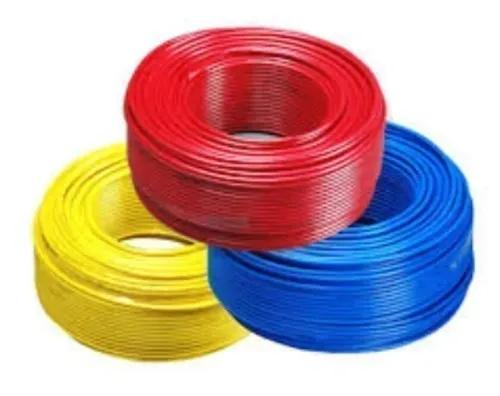
Choose flame behaviour and electromagnetic screening separately: a polycab flame retardant cable limits flame spread or self-extinguishes after the ignition source is removed, while the metallic screen manages electromagnetic noise. Neither feature replaces the other, so “polycab flame retardant cable screened cable” is not a sufficient specification.
- Request the exact manufacturer part number and construction schedule. Check conductor material and cross-sectional area, core or pair count, insulation and sheath materials, rated voltage, operating-temperature range, outer diameter and minimum bend radius.
- Confirm whether the screen serves electromagnetic compatibility, fault-current handling, mechanical protection, or only one purpose. A screen is not armour; do not assign it mechanical or protective-earth capacity without its stated cross-section, fault duty and termination method.
Match the cable data to the circuit before approving it:
| Circuit | Compare | What goes wrong if mismatched |
|---|---|---|
| RS-485 or CAN | Characteristic impedance, pair geometry, capacitance and termination | Reflections, common-mode noise or lost communication |
| Ethernet | Impedance, pair balance, attenuation and bandwidth | Packet errors or unstable links |
| Instrumentation, analogue, audio or thermocouple | Conductor resistance, pair-to-pair and pair-to-screen capacitance, grounding and material compatibility | Drift, noise or incorrect measurements |
A general screened cable can pass continuity and insulation tests yet fail in service because its impedance, capacitance or grounding arrangement is unsuitable. Use the datasheet for the purchased construction, not a generic description such as “polycab flame retardant cable.”
Select the screen construction for power, control or data duty
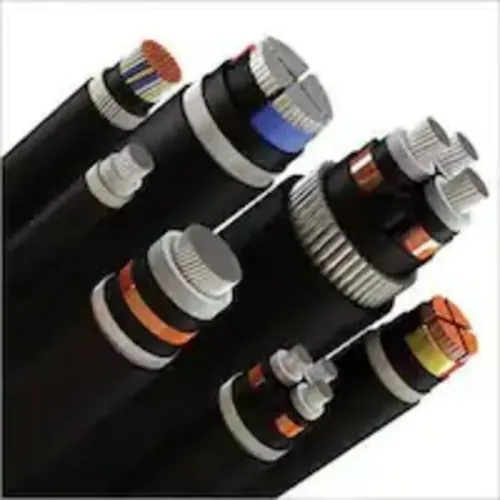
Specify the screen by frequency, circuit type, mechanical exposure and fault or bonding duty—not by the word “screened.” For a Polycab flame retardant cable, match the construction to the job:
| Screen construction | Suitable duty | Approval checks |
|---|---|---|
| Aluminium-polyester foil with drain wire | Low-frequency instrumentation and control | Coverage, drain-wire size and termination; the drain wire is not automatically a protective conductor |
| Copper tape | Power, control or bonding applications needing a defined conductive layer | Tape cross-section, overlap, short-circuit capability and gland hardware |
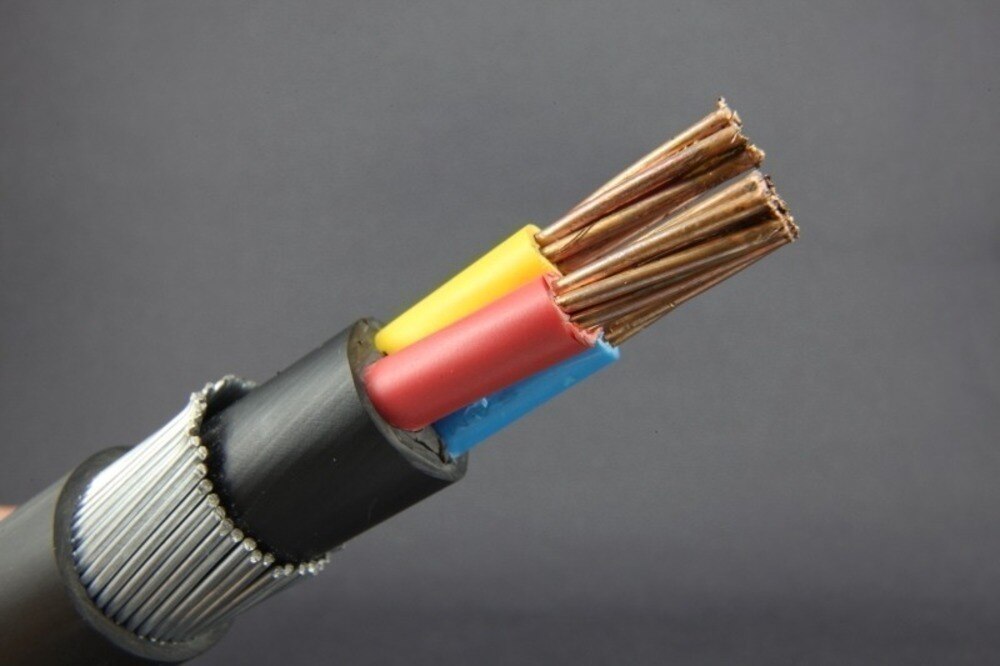
| Copper-wire braid or wire screen | Mechanically exposed circuits and higher-frequency noise control | Braid coverage, wire diameter and transfer impedance; “braided” alone is not enough |
| Foil and braid combined | Wide-frequency EMC performance and lower transfer impedance | Larger diameter, higher cost and more demanding termination |
For power circuits, confirm the screen cross-sectional area, maximum permitted fault duty and gland arrangement before assigning it a protective-earth or bonding role. A screen is not armour, so it does not automatically provide mechanical protection.
For data circuits, verify characteristic impedance, pair balance, conductor resistance, pair-to-pair and pair-to-screen capacitance, attenuation and bandwidth. A cable with the correct conductor size can still disrupt an RS-485 bus or Ethernet link.
Record these points in the design schedule:
- Whether the screen is continuous across every core or pair
- Whether a drain wire or separate earth conductor is included
- Whether the screen serves EMC, bonding, fault-current or mechanical purposes
- The manufacturer’s stated screen cross-sectional area and exact construction code
Terminate and route the screen without defeating its purpose
A screened flame-retardant cable works only if its screen remains continuous through the enclosure entry. Select a gland that matches the cable’s outer diameter, screen construction and the enclosure’s required ingress-protection rating; an ordinary non-metallic gland can leave the screen floating.
Preserve the sheath during preparation and recheck the cable’s minimum bend radius after fitting the gland.
At each equipment end, follow the manufacturer’s EMC and earthing arrangement. Where the equipment and gland permit it, use a short, continuous, preferably 360-degree screen termination; a long pigtail adds inductance and weakens high-frequency shielding.
Bonding choice depends on circuit frequency, cable length, potential difference and equipment instructions:
| Arrangement | Advantage | Use when |
|---|---|---|
| Single-end bonding | Reduces low-frequency circulating currents | The analogue or instrumentation design specifies it |
| Both-end bonding | Provides a lower-impedance high-frequency return and stronger EMC performance | High-frequency EMC control requires it and the equipment permits it |
Neither arrangement is universal. Do not cut the screen at a joint unless the design explicitly requires it; use a screened joint or approved bonding method to maintain continuity.
Keep screened power cables separated from sensitive signal wiring, even when both cables have screens. Cross power and signal routes at 90 degrees where possible. Identify the screen, drain wire and protective conductor separately: a drain wire is not automatically an earth conductor, and a screen is not automatically suitable for fault current.
Verify FR, FRLS, low-smoke and fire-survival evidence
Approve a Polycab flame retardant cable only after matching its exact construction to its fire evidence. Request the datasheet and test certificate for the exact part number, not a certificate covering a similar product family.
The documents must name the applicable cable standard, identify the flame-spread test method, and state the result or classification, such as an IEC 60332 test or the specified Indian standard.
FR and FRLS are not interchangeable. FR limits flame spread; FRLS adds reduced smoke emission. Low-smoke zero-halogen construction must be identified separately and supported by smoke and halogen-related test evidence, such as IEC 61034 and IEC 60754 where those standards apply.
| Marking or claim | What it proves | What it does not prove |
|---|---|---|
| FR | Flame-retardant behaviour | Reduced smoke or circuit survival |
| FRLS | Flame retardance and reduced smoke emission | Zero halogens or fire-survival operation |
| LSZH | Low smoke and zero-halogen material behaviour | Flame survival or circuit integrity |
| Fire-survival | Performance under a named fire test | Suitability without installation details |
Check the sheath marking against the quotation: manufacturer name, size, voltage rating, construction code, and FR or FRLS designation. Never infer FRLS from “FR.” For emergency lighting, fire pumps, alarms, or other circuits needing continued operation, request the circuit-integrity classification, exposure duration, installation method, and certificate.
A 750°C or 950°C claim means nothing without the named test.
Compare PVC FR or FRLS and LSZH against oil, solvents, UV, water, ambient temperature, and chemicals. The FR label alone does not establish environmental suitability.
Make dealer quotations technically comparable
Send every bidder the same technical schedule and require a response against every line. A quotation stating only “Polycab screened cable” does not identify the screen, pair configuration, FR or FRLS classification, or governing standard.
- Exact manufacturer part number and conductor material and size
- Core or pair count, pair geometry, insulation and sheath material
- Screen type, coverage, continuity and drain-wire size and material
- Voltage rating, temperature rating, fire classification and applicable Indian or project standard
- Outer diameter, minimum bend radius, drum length and delivery identification
Compare equivalent constructions before comparing metre rates.
| Screen detail | What to compare | Why price alone misleads |
|---|---|---|
| Foil with drain wire | Coverage, foil material and drain-wire construction | A drain wire does not automatically provide protective-earth capacity |
| Copper tape | Overlap, cross-sectional area and short-circuit capability | A thin tape may not meet a fault-current duty |
| Wire braid or wire screen | Coverage, wire diameter and transfer impedance | “Braided” does not define EMC performance |
| Foil and braid | Combined coverage and termination method | Greater performance can bring more diameter, cost and installation effort |
Request the exact datasheet, construction schedule, batch or drum number, routine-test or test-certificate details, and an invoice naming the supplied product. A screened cable dealer in Hyderabad, a polycab screened cable dealer or a polycab screened cable supplier should provide these records.
Prabhat Cables Pvt. Ltd can check an authorised Polycab quotation against this schedule for a Hyderabad or other Indian project. Keep the approved datasheet, purchase order, drum marking and incoming inspection record together for traceability.
Related product
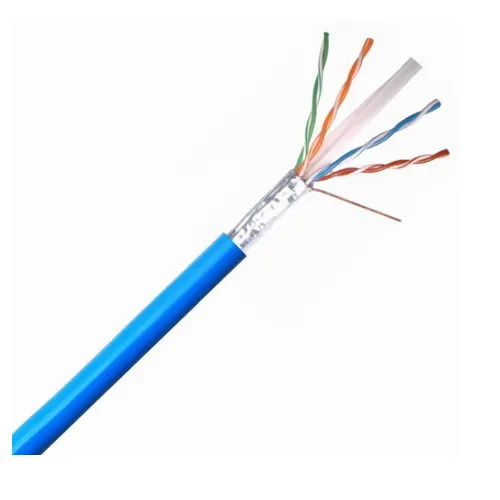 | Polycab Screened Cables Polycab screened cables are power cables designed with a metallic shield (screen) to minimize electromagnetic interference (EMI) and ensure signal... View product → |
Frequently asked questions
Does a flame-retardant cable provide electromagnetic screening?
No. Flame retardancy limits flame spread or supports self-extinguishing behaviour; a metallic foil, braid, or combined screen manages electromagnetic interference.
Which screen construction suits power, control, and data circuits?
Choose the construction based on frequency, flexibility, mechanical exposure, and required coverage: foil suits high-frequency coverage, braid adds flexible low-frequency shielding, and combined screens address both demands.
How should you terminate a screened cable?
Use a suitable gland or connector, maintain screen continuity, bond the screen as the installation design requires, and route it away from noisy power conductors.
What evidence should a dealer provide for a flame-retardant screened cable?
Ask for the exact FR or FRLS test standard, smoke and halogen information, conductor and insulation details, batch identification, and fire-survival test evidence when circuit operation must continue during fire.