The correct cable depends on four linked decisions: the number of pairs, conductor diameter, installation route and project specification. By the end, you will be able to turn a vague cable request into a purchase description, check whether the proposed Polycab cable matches it, and reject a damaged or technically incomplete delivery.
Key takeaways
- Count one pair per telephone circuit before requesting a quotation.
- Select conductor diameter using loop length and electrical limits.
- Specify sheath, filling compound and installation construction in writing.
- Check drum markings, batch details and test documents before acceptance.
Start with pairs, route length and installation method
Start by stating the number of telephone circuits, route length and installation method before asking a Polycab distributor for a quotation. Pair count equals circuits: a 100-pair cable contains 200 insulated copper conductors.
| Pair count | Usual application |
|---|---|
| 10-pair | Small building or short distribution point |
| 20-pair | Small office or residential block |
| 50-pair | Moderate subscriber distribution |
| 100-pair | Larger building or local network |
| 200-pair | High-capacity distribution |
| 400-pair | Large exchange or network route |
Larger network-project cables must match the project schedule; do not assume standard stock is interchangeable.
Your request must also state:
- Route length, spare-pair allowance and required drum length
- Duct installation or direct burial
- Building entry point and telecom-chamber arrangement
- Underground or duct-rated jelly-filled construction, not generic indoor telephone cable
- Moisture-resistant sheath and intended environment
Bhubaneswar’s monsoon exposure makes the sheath specification important, particularly where water can collect in ducts, chambers or soil. A jelly-filled underground cable is not an automatic substitute for an indoor cable, and an indoor cable is not suitable merely because it fits the route.
Do not select Polycab jelly-filled telephone cables by outside diameter. Two cables with similar external dimensions can have different conductor diameters, pair counts and usable electrical performance. Ask for the current Polycab schedule and datasheet, including conductor size, sheath rating and drum length, before approving a quotation.
Match conductor diameter to loop length and electrical limits
A 0.4 mm conductor suits shorter copper loops with ordinary electrical limits; 0.5 mm offers a useful step up for access and distribution work. The larger 0.63 mm and 0.9 mm conductors reduce conductor resistance further, making them generally better for longer loops or tighter voltage-drop, loop-resistance and transmission-loss limits.
| Nominal conductor diameter | Electrical effect | Selection use |
|---|---|---|
| 0.4 mm | Highest resistance of these sizes | Shorter loops with adequate calculated margin |
| 0.5 mm | Lower resistance than 0.4 mm | Ordinary access and distribution routes |
| 0.63 mm | Lower loop resistance | Longer routes or stricter voltage-drop limits |
| 0.9 mm | Lowest resistance of these options | Long loops where attenuation or transmission loss is tightly limited |
The available pair-count combinations are product-specific, so check the current Polycab schedule before quoting any jelly filled telephone cable sizes. Increasing pair count does not reduce resistance; it only provides more circuits. A 100-pair cable has 200 insulated copper conductors, while a 200-pair cable can use the same conductor diameter.
Request these datasheet values before approving the selection:
- Conductor resistance and insulation resistance
- Conductor-to-conductor capacitance and capacitance unbalance
- Attenuation and impedance, where specified
A cable acceptable for voice service is not automatically suitable for a required xDSL distance or data rate. The quotation must identify solid copper, insulation material, nominal conductor diameter and the applicable electrical test values, rather than saying only “telephone cable.”
Confirm the sheath, filling and installation construction
Choose the construction against the route, not the label. Polycab jelly filled telephone cables usually contain solid copper conductors, polymer insulation, a water-blocking compound and an external polymer sheath.
Confirm these details before approving the quotation:
- Check the current Polycab datasheet for a metallic screen, drain wire, armour, rip cord or special outer jacket. “Jelly filled” does not prove that any of these features is present.
- Require the quotation to state whether the cable is for duct, underground, direct-burial, aerial, building-entry or telecom-chamber use. A generic indoor telephone cable is not an automatic substitute for a moisture-exposed route.
- Confirm the sheath is suitable for Bhubaneswar’s monsoon exposure and the specified installation method.
- Treat petroleum jelly as longitudinal water blocking: it limits water movement through spaces around insulated pairs after sheath damage or moisture entry. It does not waterproof an open end, damaged sheath or unsealed joint.
- Specify the manufacturer-compatible jointing method, termination module, distribution box, connector, gland and sealing compound.
- Keep exposed cable ends capped during storage and installation, then seal each joint and termination correctly.
- Follow the current Polycab limits for pulling tension and minimum bend radius. A sharp bend, excessive pull or manhole-edge scrape can damage the sheath and defeat the filling system.
A jelly-filled cable can control moisture migration, but it cannot repair poor installation. Confirm the route rating and accessories before the drum reaches site.
Build a technically complete quotation with the right accessories
A comparable quotation names conductor diameter, pair count, nominal drum length, sheath construction, installation rating, applicable standard or purchaser specification, and whether the cable is screened or armoured. “Polycab jelly filled telephone cable” alone does not establish technical equivalence.
1. State the route length, required pairs, spare-pair allowance, installation method, project standard and termination type. A telephone cable supplier in Bhubaneswar should not recommend 0.5 mm or a larger conductor from pair count alone; longer loops and tighter resistance or transmission limits may require the larger conductor.
2. Identify the exact Polycab schedule, solid copper conductor diameter, insulation, sheath, drum length and electrical data. Compare 0.5 mm with a larger conductor only against conductor resistance, insulation resistance, capacitance, attenuation and impedance limits. Include the installation rating for duct, underground or direct-burial use. State whether the cable is screened or armoured.
3. Attach the manufacturer’s colour code and pair-numbering scheme, especially for large cables. Preserve sequential pair records after cutting a drum; losing them causes termination and fault-location errors. List compatible joint closures, termination modules, distribution boxes, connectors, glands and approved sealing compounds.
For a request for a Polycab distributor jelly filled telephone cable in Bhubaneswar, Prabhat Cables Pvt. Ltd can confirm current Polycab schedules, stock status and project-specific documents instead of quoting an unspecified family. Ask for route length, pair requirement, installation method, project standard and termination type before accepting the quotation.
Related product
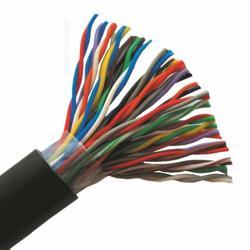 | Polycab Jelly Filled Telephone Cables Polycab Jelly Filled Telephone Cables Polycab Jelly Filled Telephone Cables are designed for outdoor telephone communication, offering protection against moisture, rodents, and other... View product → |
Inspect the drum, markings and documents before acceptance
Accept the drum only when its markings, documents and physical condition agree with the purchase order. For polycab jelly filled telephone cables, the receiving team should check:
- Printed sheath markings: manufacturer name, cable type, pair count and conductor size
- Batch or drum number, manufacturing date and sequential metre markings
- Datasheet and test certificate supplied with the drum
- Intact drum wrapping, with no crushed flanges or broken battens
- Undamaged end seals, cable ends and outer sheath
- No cuts, abrasions, dried filling compound or leaking filling compound
Compare every marking with the purchase order, including the specified jelly filled telephone cable sizes. A broken end seal can admit moisture even when the outer sheath looks intact. Keep both ends sealed until termination.
| Condition | Receiving action |
|---|---|
| Matching label and clean drum | Record the drum and accept it |
| Mismatched label or missing documents | Quarantine and seek project-engineer approval |
| Crushed drum, sheath damage or leaking compound | Reject or quarantine before pulling cable |
| Broken end seal or damaged cable end | Quarantine for inspection; do not install |
The project engineer must record the drum number, markings, seal condition, visible damage and acceptance decision. Do not pull a drum with a mismatched label or visible damage.
Supply the Polycab cable whose conductor diameter, pair count, sheath construction, installation method, drum length and electrical data match the project schedule—not the cable with the largest pair count or the closest-looking outside diameter.
Frequently asked questions
How many pairs do you need for a telephone cable?
Match one cable pair to each telephone circuit. A 100-pair cable contains 200 insulated copper conductors.
How does route length affect telephone cable selection?
Use the complete loop length, including the outgoing and return conductors, when checking conductor resistance and electrical limits.
What construction details should a quotation specify?
State the sheath material, jelly filling, conductor diameter and whether the cable is intended for duct, direct-buried or other installation.
What should you inspect before accepting a cable drum?
Check the drum label, pair count, cable size, manufacturer markings, batch details, seal condition and accompanying test documents.