Choosing coaxial cable by thickness or brand name alone can create signal loss, impedance mismatch and unreliable terminations. By the end, you will be able to match cable construction, connectors, installation method and purchase records to CATV, CCTV, satellite, antenna and RF requirements.
Key takeaways
- Match cable impedance to the equipment: 50 ohms or 75 ohms.
- Compare attenuation, shielding, bandwidth, jacket rating and connector compatibility.
- Use matching connectors and proper termination to prevent reflections and hidden losses.
- Request batch details and invoices from an authorised Polycab dealer for traceability.
Why coaxial cable benefits depend on the application
Coaxial cable is useful because its central conductor, dielectric, shield and outer jacket maintain controlled impedance around the signal path. These coaxial cable benefits produce predictable high-frequency transmission, reduce electromagnetic interference and support longer runs than many unshielded signal cables.
Choose the impedance first: 75-ohm cable suits television and video distribution, while 50-ohm cable suits radio-frequency and test systems; mixing them creates reflections and signal loss.
| Cable option | What it does better | When it is the better choice |
|---|---|---|
| Coaxial cable | Shields the signal and preserves impedance at high frequencies | Television, CCTV video, broadband, antennas and RF equipment |
| Optical fibre | Carries data as light and ignores electrical interference | Very long links, lightning-exposed routes, high bandwidth and electrical isolation |
| Ethernet cable | Carries network data through twisted pairs and supports structured networking | Computer networks, switches, power over Ethernet and building data systems |
| Telephone wire | Provides low-bandwidth voice or basic signalling | Legacy telephone extensions and simple low-frequency circuits |
| Ordinary electrical wire | Carries power rather than a controlled high-frequency signal | Mains, lighting, motors and low-voltage power distribution |
Coaxial cable is not automatically the best option. Fibre wins where electrical isolation or distance matters, Ethernet wins where network equipment and two-way data are central, and electrical wire is the wrong substitute for a sensitive RF signal.
Match the cable to the equipment, frequency, run length and connector system rather than choosing by outside diameter alone.
Which coaxial cable specifications must you compare
Compare the cable’s RG designation, impedance and construction against the equipment before comparing price. RG identifies a cable family, not guaranteed performance; use the manufacturer’s datasheet to confirm attenuation, dimensions and frequency limits for polycab coaxial cables.
| Specification | Compare | Why it decides fit |
|---|---|---|
| RG designation | RG-6, RG-59, RG-11 or the specified family | Indicates a construction family; the datasheet still decides loss, diameter and connector fit. |
| Impedance | 75 ohms or 50 ohms | Television, CATV and video usually use 75 ohms; RF, radio and test equipment commonly use 50 ohms. Mixing them creates reflections. |
| Conductor | Solid or stranded; copper, copper-clad steel or another material | Solid copper suits low-loss fixed runs; stranded cable bends more easily but can have different loss and termination requirements. |
| Dielectric | Material, thickness and foam or solid construction | A lower-loss dielectric supports longer or higher-frequency runs, while changing its geometry alters impedance. |
| Shielding | Foil, braid coverage, braid construction and stated shielding effectiveness | Braid percentage alone is incomplete. Poor shielding or termination permits electromagnetic interference in or signal leakage out. |
| Jacket | PVC, flame-retardant, UV-resistant or outdoor-rated material | Choose the jacket for indoor routing, sunlight, moisture, temperature and fire conditions. |
| Diameter | Overall diameter and minimum bend radius | Larger cables can reduce loss but need more space, force and compatible connectors. Kinking creates an impedance discontinuity. |
| Frequency range | Rated operating range and attenuation at your frequency | Check loss at the actual frequency and run length; a cable acceptable for CCTV can perform poorly at satellite or RF frequencies. |
Follow the manufacturer’s bend-radius and pulling-tension limits. A larger, better-shielded cable is not automatically the right choice if routing space or connector compatibility is limited.
How to match cable, connector and termination to the equipment
Use 75-ohm coaxial cable for television and video systems, and 50-ohm cable for radio-frequency equipment. Mixing them creates an impedance discontinuity, reflected power and signal loss.
| Application | Cable and connector | Termination |
|---|---|---|
| CATV distribution | 75-ohm RG6 or RG59 with an F connector | Fit a compression F connector; bond the shield and cap unused outlets with 75-ohm terminators. |
| Broadband modem | 75-ohm RG6 with an F connector | Use a correctly sized compression connector, keeping the centre conductor straight and the braid outside the clamp. |
| CCTV video | 75-ohm RG59 or RG6 with a BNC connector | Crimp or compress the BNC onto the cable; do not substitute a power-and-video combination cable for coaxial video alone. |
| Satellite TV | 75-ohm, low-loss RG6 with an F connector | Use compression F connectors, maintain the shield, and seal outdoor joints against water while preserving DC power to the LNB. |
| Antenna | 75-ohm RG6 with an F connector | Terminate at the antenna and television with matching connectors; use a 300-to-75-ohm balun for twin-lead antenna terminals. |
| RF or radio equipment | 50-ohm RG58, RG213 or low-loss 50-ohm cable with BNC, N-type or SMA connectors | Match the connector to the equipment and finish the unused port with a 50-ohm load. |
Cable diameter determines connector size. Ask for the exact Polycab part number, not simply “coaxial cable”; a search for polycab authorized dealer coaxial cable in pune does not replace checking impedance, attenuation and connector compatibility.
How an authorised dealer supports a traceable cable purchase
A traceable purchase identifies the exact Polycab part number, construction, reel length, batch or manufacturing details, invoice and warranty terms. “Polycab coaxial cable” alone is too vague for approving a substitution or investigating signal loss later.
Before accepting a quotation from a Polycab dealer or Polycab authorized dealer, ask for:
- The exact part number, nominal impedance, attenuation at your operating frequency, shielding specification and intended application
- Reel length, stock location, manufacturing or batch details, and packaging-label photographs
- A tax invoice naming the supplied product, seller details, applicable GST information and stated warranty conditions
- Confirmation that connectors and termination parts match the cable and the project’s 50-ohm or 75-ohm system
Verify the seller through Polycab’s current authorised-channel information. An authorised-dealer label does not prove that every reel is genuine or that every installation qualifies for warranty; retain the invoice, sealed packaging, labels and batch information.
For a search such as Polycab authorized dealer coaxial cable in Pune, confirm whether the stock is actually in Pune, the promised delivery date, reel length and transport conditions.
Local stock can prevent a delay, but it does not replace checking attenuation against the installed length, impedance against the equipment, shielding against the interference environment and connector compatibility. Prabhat Cables Pvt. Ltd can provide a useful procurement route when these model-level records accompany the quotation and delivery.
Related products
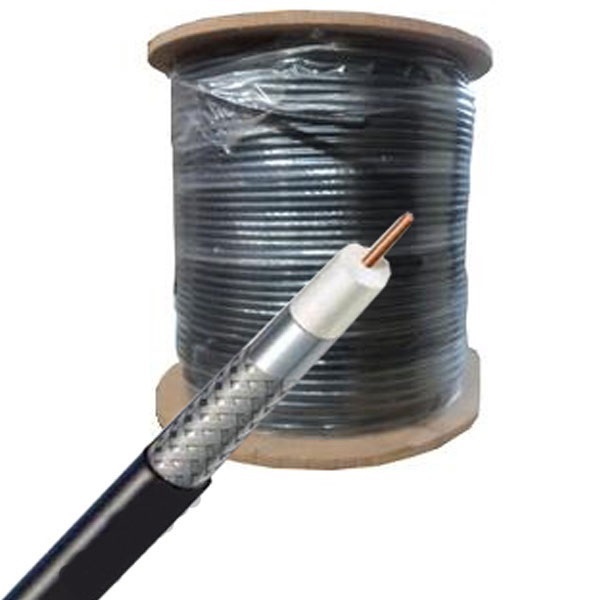 | Polycab Co-Axial Cables Polycab coaxial cable is a type of cable designed for transmitting high-frequency electrical signals, commonly used in cable television (CATV) and... View product → |
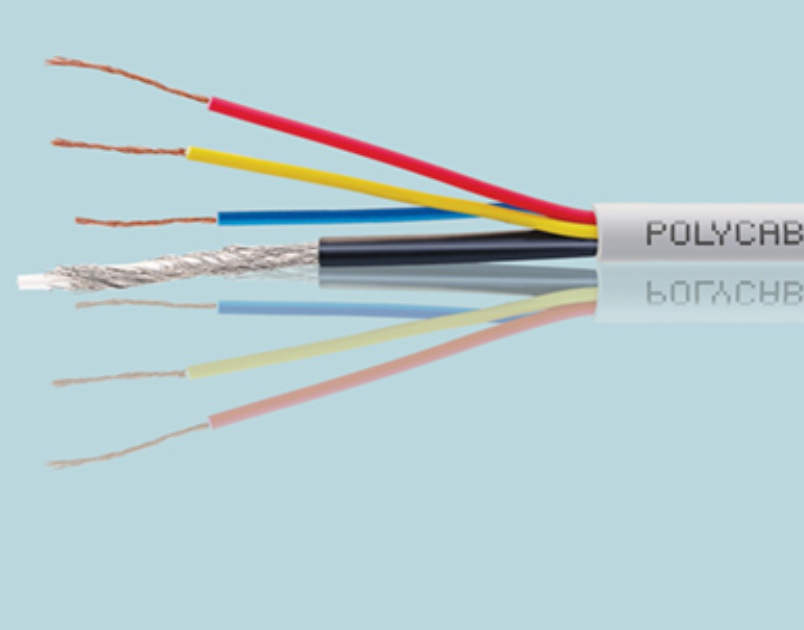 | Polycab CCTV Cables Polycab CCTV cables are specifically designed for use in closed-circuit television (CCTV) systems, offering reliable video signal transmission and... View product → |
How to install and test a coaxial run without creating hidden losses
Keep the cable round, dry and correctly terminated from reel to equipment; a crushed section can create hidden loss even when the jacket looks perfect. Install Polycab coaxial cables within the manufacturer’s minimum bend radius and pulling-tension limit, and do not drag a connector through conduit.
For an outdoor or rooftop run, confirm that the jacket is marked for the exposure: UV resistance, water protection, operating temperature range and flame performance. Bond and earth the shield according to the installation design. An indoor-rated jacket can crack in sunlight or admit water, erasing the coaxial cable benefits you expected.
- Leave a service loop without tightly coiling the cable.
- Keep coax away from sharp edges, heat sources and parallel power conductors.
- Strip only the specified length; do not nick the braid, deform the dielectric or leave loose strands.
- Fit the connector for the cable’s impedance and secure it with the specified crimp or compression method.
- Label both ends with route and equipment identifiers.
Check each finished run before energising it.
| Check | What to verify | Failure exposed |
|---|---|---|
| Visual | Jacket, bends, connectors and weather seals | Crushing, cuts or water entry |
| Continuity | Centre conductor and shield; no centre-to-shield short | Open or short circuit |
| RF test | Insertion loss at the operating frequency and installed length | Excessive attenuation |
| Return-loss or VSWR test | Results within the equipment or design limit | Impedance mismatch and reflections |
A continuity pass alone proves little. Test the actual signal path at its working frequency; a cable acceptable at 100 MHz can fail at a much higher frequency.
Frequently asked questions
What are the main benefits of coaxial cable?
Coaxial cable provides controlled impedance, shielding against electromagnetic interference and predictable high-frequency signal transmission.
Which coaxial cable specifications should you compare?
Compare impedance, operating frequency, attenuation, shielding construction, velocity factor, conductor size, jacket material and temperature rating.
How do you match a coaxial cable to connectors and equipment?
Match the cable impedance and frequency range to the equipment, then select connectors designed for that cable diameter and interface.
How can you install and test a coaxial cable run?
Keep bends within the stated minimum radius, avoid crushing or sharp kinks, tighten connectors correctly and test continuity, impedance and insertion loss.