Choosing an optical fibre cable starts with the route, endpoint equipment and future capacity—not with the largest reel or the lowest price per metre. By the end, you will be able to define the fibre type, construction, count, accessories and acceptance records a supplier must provide for your Guwahati installation.
Key takeaways
- Compare single-mode and multimode against distance, data rate, and installed optics.
- Define route length, duct conditions, fire exposure, and installation method first.
- Choose fibre count with spare capacity for repairs, expansion, and failed strands.
- Ask a Polycab distributor to match products, not approve network design.
Start with the link: single-mode or multimode?
For a telecom route, inter-building campus link, CCTV backhaul or normal access connection, compare single-mode first. It usually gives the distance and reach needed for an optical fibre cable in Guwahati, but confirm the data rate and installed optics before ordering.
| Fibre choice | Typical fit | What to confirm |
|---|---|---|
| G.652.D single-mode | Conventional telecom and access routes | SFP type, wavelength, reach and data rate |
| G.657 single-mode | Routes requiring tighter fibre bends | Assembly, closure, patch-panel and connector bend limits |
| OM3 or OM4 multimode | Short, high-speed data-centre links | Compatible multimode transceivers and maximum reach |
| OM5 multimode | Wideband multimode operation | Equipment and wavelength plan explicitly supporting OM5 |
Ask for the exact ITU-T fibre type on the datasheet. G.652.D is conventional single-mode fibre; G.657 is bend-insensitive single-mode fibre, not permission to exceed the cable assembly’s bend radius or mishandle closures, patch panels and connectors. Choose OM3, OM4 or OM5 only when the installed transceivers and link design require that category.
“High speed” alone is not a specification.
Build the link budget from the endpoint equipment datasheets. Include fibre attenuation, splice loss, connector loss, passive splitter loss where applicable and an engineering margin, then compare the total with the actual transmitter and receiver limits. A distributor can compare cable figures, but cannot validate the link without the route length and optical equipment.
Specify the route before asking for a cable
Request the cable construction against the route, not just the fibre count. State the installation environment in the purchase request.
1. Indoor: request tight-buffered cable for building pathways, risers and simpler termination. Do not use it for exposed outdoor spans or wet ducts unless the datasheet permits those conditions.
2. Duct: request outdoor loose-tube cable with water-blocking elements, a suitable sheath and specified pulling limits. Confirm the maximum pulling tension, crush resistance, minimum installation bend radius and minimum long-term operating bend radius.
3. Aerial: request ADSS when the cable must span poles without a metallic messenger. Messenger-supported aerial cable solves a different support problem; do not substitute one for the other.
4. Direct burial: request armoured cable when the route needs added mechanical protection, but do not assume every underground route needs armour. Ask for impact performance, crush resistance, maximum pulling tension, and whether the armour is electrically continuous or requires bonding and earthing.
For Guwahati, identify monsoon water entering ducts, saturated soil, exposed spans, construction damage, rodents and access for repair. The offer must name the sheath material, sheath colour, water-blocking method, operating and installation temperature ranges, and installation conditions.
A search for polycab distributor optical fibre for cable in guwahati does not establish any of these properties. Request the manufacturer’s datasheet for the exact construction and reel, not a generic “outdoor” description.
Size fibre count and compare the technical datasheet
Start with the active-fibre count, then add spare capacity for protection, restoration, planned buildings, distribution points and expansion. Do not choose the largest stock reel before calculating the route.
| Core count | Suitable planning case | Capacity decision |
|---|---|---|
| 4-core | Small point-to-point link | Lowest capacity; limited repair options |
| 8-core or 12-core | Working links with spare fibres | Supports restoration and modest expansion |
| 24-core or higher | Routes serving several buildings or future branches | More distribution and expansion capacity |
Compare the supplied cable’s datasheet, not only its product name. Check attenuation in dB/km at the wavelengths used by your transceivers, maximum tensile strength, crush resistance, operating and installation temperature ranges, minimum installation and long-term bend radii, sheath material, sheath colour, cable diameter and water-blocking method.
Confirm the reel length and permitted pulling tension against the civil route.
Request factory records for the actual reel:
- Attenuation by wavelength
- Continuity results
- Fibre identification
- Measured cable length
- Reel or batch traceability
A generic catalogue page does not prove the condition or measured performance of that reel. A search for “polycab optical fibre distributor” identifies a sourcing option, not a substitute for technical verification.
Separate the cable price from closures, splice trays, pigtails, patch panels, adapters, pulling accessories, splicing, testing and route restoration. A low price per metre can conceal missing hardware and installation costs.
Match the cable to terminations and network equipment
An apparently suitable reel becomes incompatible when its termination plan does not match the installed optics. Inventory the equipment before ordering:
- LC, SC or ST connectors, including simplex or duplex requirements
- Splice closures and trays
- Patch panels, adapters and pigtails
- SFP modules and media converters
Confirm whether installers will fusion-splice the route cable to pigtails or receive a pre-terminated assembly. Match the connector polish, such as UPC or APC, and the adapter type to the SFP, patch panel or converter specification. A Polycab fibre cable supplier should confirm these interfaces in writing rather than quote only a cable reel.
Do not substitute cable types. LAN cable is the wrong choice for a long outdoor fibre route; coaxial cable uses a different conductor and shielding arrangement; telephone wire cannot connect optical transceivers; and a fibre patch cord is a short termination lead, not a replacement for the route cable.
Include connector inspection and cleaning in the installation method. Dust can create insertion loss and reflection, then permanently damage an end face if it is mated under contamination.
Require end-to-end insertion-loss testing with a calibrated light source and power meter. Use an OTDR with suitable settings, launch fibre and receive fibre to locate breaks, bad splices, connector reflections and unexpected events. An OTDR trace alone is not complete acceptance evidence.
Use a distributor for product matching, not design sign-off
A distributor can verify product availability and compatibility, but cannot approve your network design. Treat a search for “polycab optical fibre distributor” or “polycab fibre cable supplier” as a sourcing lead, not proof of authorisation.
1. Give the supplier a written schedule stating fibre count, G.652.D or G.657 type, OM category where relevant, indoor or outdoor construction, aerial, duct or direct-burial route, sheath material, water-blocking method, tensile rating, bend radius, attenuation and acceptance tests.
2. Ask the distributor to map that schedule to an available Polycab construction, confirm whether the offered item is a current SKU, and provide its datasheet and reel or batch details. Confirm reel length and lead time before approving the purchase.
3. Have the supplier assemble compatible closures, splice trays, pigtails, patch panels, adapters and testing services. Prabhat Cables Pvt. Ltd can support this sourcing and product-matching step for buyers seeking Polycab optical fibre cable in Guwahati.
4. Verify the exact Polycab business authorisation, invoice entity, product warranty and current SKU. Keep final responsibility for the optical budget, civil route, earthing treatment, endpoint compatibility and acceptance criteria with your network designer or buying team.
That division prevents a catalogue recommendation from becoming an unsuitable network design.
Related product
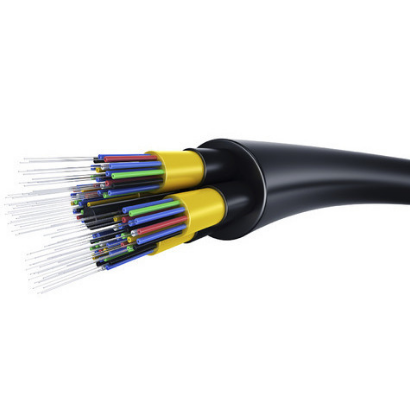 | Polycab Optical Fibre Polycab Optical Fiber refers to the Optical Fiber Cables (OFCs) manufactured and distributed by Polycab Telecom, a division of Polycab India Ltd. View product → |
Frequently asked questions
Should you choose single-mode or multimode optical fibre?
Compare single-mode first for telecom, inter-building, CCTV backhaul, and longer access links. Choose multimode when the distance, data rate, and installed multimode optics support it.
What route details should you provide before ordering optical fibre cable?
Provide route length, indoor or outdoor sections, duct or aerial installation, bend risks, pulling conditions, water exposure, and fire requirements.
How do you choose the correct fibre count?
Count active links, add spare fibres for repairs and expansion, then compare the total with available cable constructions and termination capacity.
Can a Polycab distributor approve your fibre network design?
A distributor can match cable, fibre type, construction, and accessories to your stated requirements. A qualified network designer must sign off the complete design.